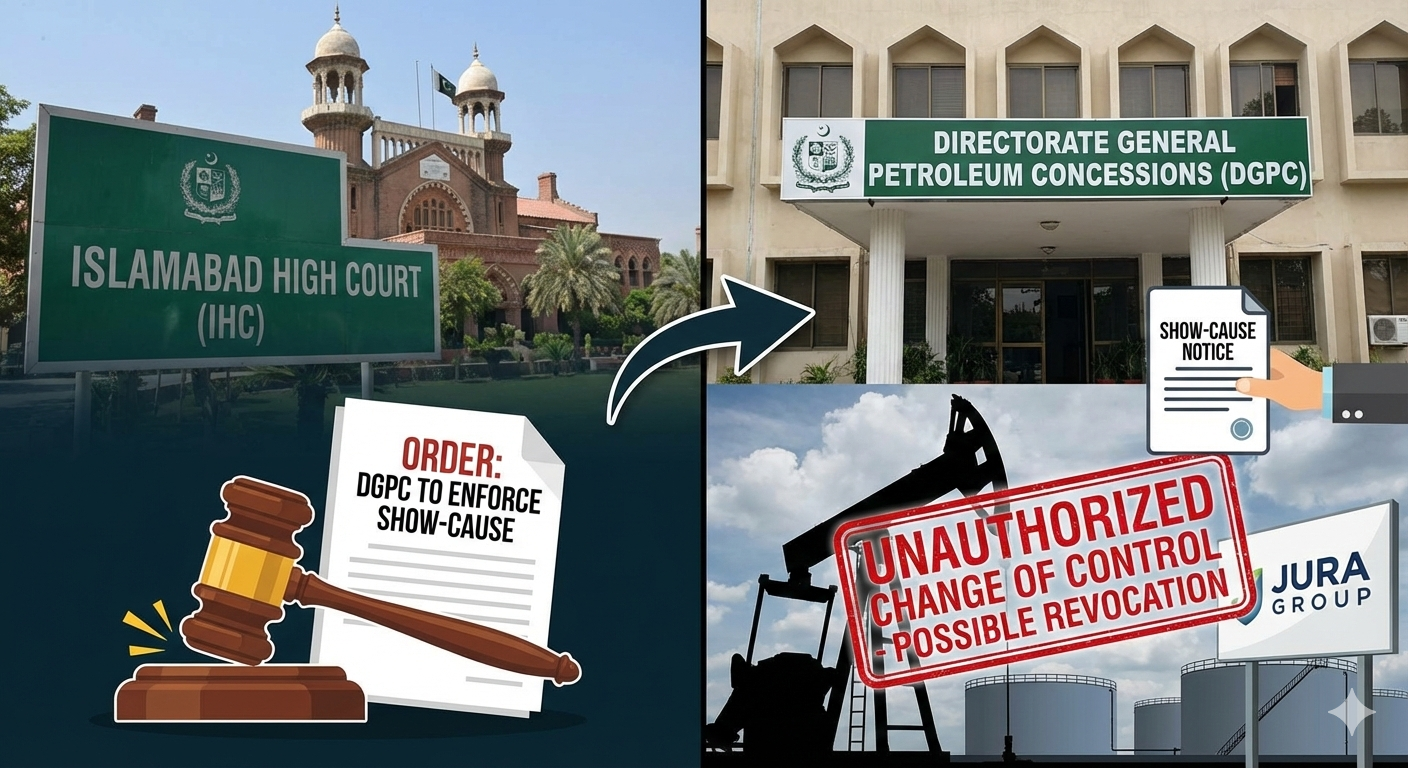
In a major setback for Jura Energy-linked companies, the Islamabad High Court (IHC) has directed the Petroleum Division and the Directorate General of Petroleum Concessions (DGPC) to immediately proceed under law against Frontier Holdings Limited (FHL) and Spud Energy Pty Ltd (SPUD) over an alleged unauthorized change of effective control, a violation that could result in revocation of petroleum rights.
According to details, the IHC issued a decisive order in Writ Petition No. 4195 of 2025, directing the Ministry of Energy (Petroleum Division) and DGPC to take the show-cause proceedings to their legal conclusion expeditiously and strictly in accordance with law, effectively eliminating any room for further administrative delay.
The case revolves around an alleged transaction executed in early 2025, under which Jura Energy Corporation reportedly transferred effective control of its corporate group, including FHL and SPUD, to IDL Investments Limited, through an offshore arrangement. This transfer, according to the petitioners, was made without seeking prior approval from the Government of Pakistan, which is mandatory under Pakistan’s petroleum regulatory regime.
Under Pakistan’s petroleum framework, any disposal of share capital, restructuring, or ownership arrangement that results in a change of effective control, whether direct or indirect, requires prior consent from the government through DGPC. The requirement exists to ensure that Pakistan retains sovereign oversight over entities holding petroleum exploration and production rights.
Following complaints and regulatory correspondence, DGPC issued a Show Cause Notice dated July 18, 2025, invoking Rules 68(d) and 69(d) of the Petroleum Rules. These provisions empower the government to initiate enforcement action, including revocation of petroleum rights, in cases of non-compliance such as unauthorized transfer of ownership or control.
However, despite issuance of the show-cause notice, the enforcement process reportedly did not progress at the pace expected, leading to concerns within industry circles about regulatory hesitation in a strategically sensitive sector.
This delay ultimately pushed the matter into litigation, prompting petitioners to approach the Islamabad High Court seeking directions for the state authorities to implement the law and proceed with enforcement action.
During the proceedings, DGPC’s reply emerged as a key turning point. Instead of disputing the alleged breach, DGPC reaffirmed in its submission that petroleum right holders are under a strict statutory and contractual obligation to comply with the Petroleum Exploration and Production Policy 2012 and relevant Petroleum Rules.
DGPC emphasized that any transfer of ownership, restructuring, or change in effective control can only be carried out with prior approval of the Government of Pakistan, acting through DGPC. The regulator stated that the requirement is meant to safeguard Pakistan’s sovereign, fiscal and regulatory interests, ensuring that strategic petroleum rights remain subject to state oversight.
More significantly, DGPC acknowledged that breach of this mandatory approval requirement may expose the petroleum right to enforcement action under the Petroleum Rules, reinforcing the applicability of Rule 69(d) to the case.
Legal and regulatory observers believe DGPC’s own position before the court has effectively weakened any argument that parent-level offshore shareholding changes fall outside the scope of petroleum regulation. DGPC neither claimed that approval was unnecessary nor denied that effective control had changed, which strengthened the petitioners’ case.
With the IHC’s directive now in place, it has become binding on the Petroleum Division and DGPC to proceed with the show-cause notice and complete the process under the law, shutting the door on further administrative inaction.
Industry insiders said the court order has placed DGPC under a clear legal obligation to enforce Rule 69(d), which provides for revocation of petroleum rights as a consequence of unauthorized changes in effective control.
The case is being closely watched as a major test of Pakistan’s regulatory credibility in the petroleum sector, where compliance with concession agreements, licensing conditions, and sovereign oversight is viewed as essential to protecting national energy security.
Industry sources believe the final outcome may set a landmark precedent for future enforcement, signaling that offshore corporate restructuring and behind-the-scenes changes of control cannot be used to bypass Pakistan’s petroleum governance framework.
With the Islamabad High Court now formally stepping in, the case has shifted from a regulatory dispute into a high-profile accountability test, where the key question is no longer whether the law was violated, but whether the state will enforce the prescribed consequence under the petroleum rules — including possible revocation of petroleum rights.
IHC Orders DGPC to Enforce Show-Cause Against Jura Group Firms Over Unauthorized Change of Control, Petroleum Rights at Risk of Revocation