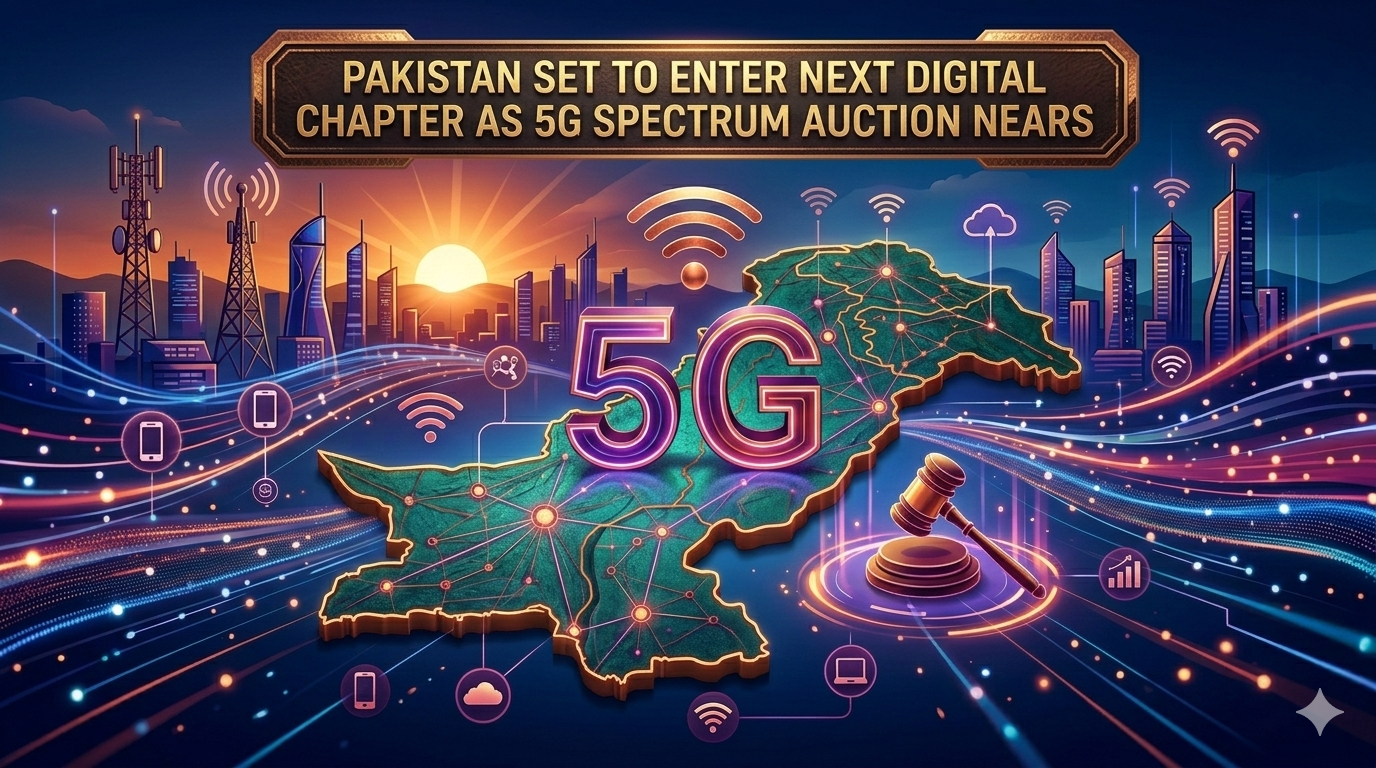
Pakistan is preparing to take a major step toward advanced digital connectivity as the country moves closer to conducting its Next Generation Mobile Services (NGMS)/5G spectrum auction, a development expected to reshape the telecom and technology landscape.
The Pakistan Telecommunication Authority (PTA) has announced that the spectrum auction ceremony will be held on 10 March 2026 in Islamabad, marking the formal commencement of the bidding process for high-speed mobile broadband frequencies.
Officials said the auction will offer nearly 600 MHz of spectrum across multiple frequency bands, including low, mid, and high-frequency blocks, which are essential for the efficient deployment of next-generation wireless communication networks.
Industry estimates suggest that the auction could generate $300 million to over $700 million in non-tax revenue for the national exchequer, depending on bidder participation, market competition, and final spectrum pricing.
The auction will be conducted using a multi-round electronic clock mechanism, with initial spectrum offerings expected in the 2600 MHz and 3500 MHz bands. These bands are globally recognized as core spectrum resources for 5G deployment due to their ability to support high-speed, low-latency communication services.
Sources indicated that the government may earn around $300 million if approximately 300 MHz of spectrum is acquired without intense competitive bidding. However, stronger market interest could push total revenue closer to the higher projection.
To facilitate telecom infrastructure expansion, authorities have reduced Right of Way (ROW) charges from Rs26,000 per kilometre to zero, a policy aimed at accelerating fiber network installation and reducing deployment costs for operators.
Following successful auction completion, preliminary rollout of 5G services is expected within three to six months, depending on network installation, equipment readiness, and operator investment plans.
Industry stakeholders believe that 5G technology will support digital innovation by enabling Internet of Things (IoT) applications, smart industrial systems, telemedicine services, and next-generation mobile platforms.
Pakistan’s cellular sector currently operates on about 274 MHz of spectrum, which is considered insufficient compared to the country’s rapidly growing mobile subscriber base exceeding 240 million users.
Authorities believe that spectrum expansion will help reduce network congestion, improve broadband quality, and support long-term digital infrastructure development.
The government is also planning phased expansion of high-speed connectivity coverage across major urban centers, aligning telecom modernization with future economic and industrial digitization goals.
