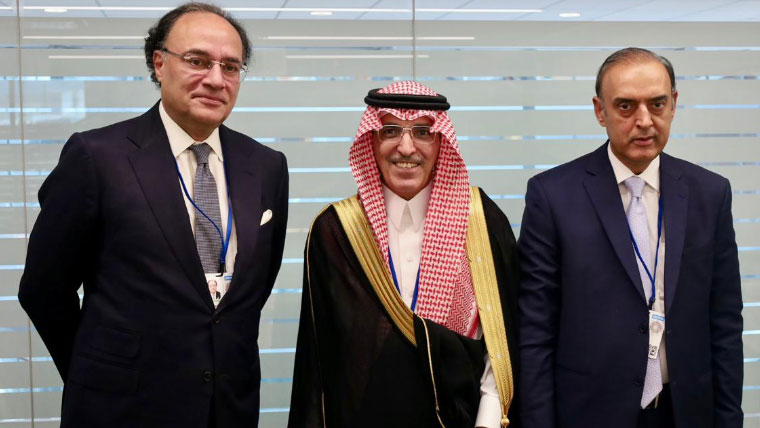
Pakistan’s external position strengthened significantly as Saudi Arabia approved $3 billion in fresh financial support and extended its existing $5 billion deposit, providing timely relief after major external repayments.
Federal Finance Minister Muhammad Aurangzeb announced that the Kingdom has approved an additional $3 billion in deposits for Pakistan, with inflows expected next week, according to a statement issued by the Finance Ministry.
He further revealed that Saudi Arabia’s existing $5 billion deposit will no longer be subject to annual rollover conditions and has instead been extended for a longer tenure, easing pressure on Pakistan’s external financing needs.
The announcement comes after Pakistan made significant external payments to the United Arab Emirates earlier this month, marking a key development in stabilizing the country’s financial outlook.
Speaking to media on the sidelines of the World Bank and IMF Spring Meetings 2026 in Washington, D.C., Aurangzeb termed the Saudi support “critical and timely,” noting that it would help strengthen foreign exchange reserves and stabilize external accounts.
He reiterated the government’s commitment under the International Monetary Fund programme to raise reserves to around $18 billion—equivalent to approximately 3.3 months of import cover.
Highlighting recent developments, the minister said Pakistan successfully repaid a $1.4 billion Eurobond last week, describing it as a “non-event” and reaffirming the government’s resolve to meet all external obligations on time.
Aurangzeb also disclosed that he held detailed discussions with Saudi Finance Minister Mohammed bin Abdullah Al-Jadaan in Washington, alongside the Governor of the State Bank of Pakistan and Pakistan’s ambassador to the United States. He noted that prior engagements had also taken place in Islamabad, though no formal announcement was made until confirmation.
Expressing gratitude, the finance minister thanked the Saudi leadership, particularly Crown Prince Mohammed bin Salman, for their continued support to Pakistan.
He also acknowledged the role of Pakistan’s economic team, including the prime minister, the finance ministry, and central bank officials, in steering the country through a challenging external financing environment.
Aurangzeb said improving investor confidence and maintaining a positive global perception remain critical, adding that Pakistan is receiving strong engagement from international financial institutions, including the World Bank, IMF, and global investors.
As part of its broader external financing strategy, Pakistan is also working on launching a Global Medium-Term Note programme and issuing Panda bonds to diversify funding sources.
The minister reaffirmed the government’s commitment to sustaining economic stability, meeting external obligations, continuing structural reforms, and strengthening partnerships with international stakeholders.
