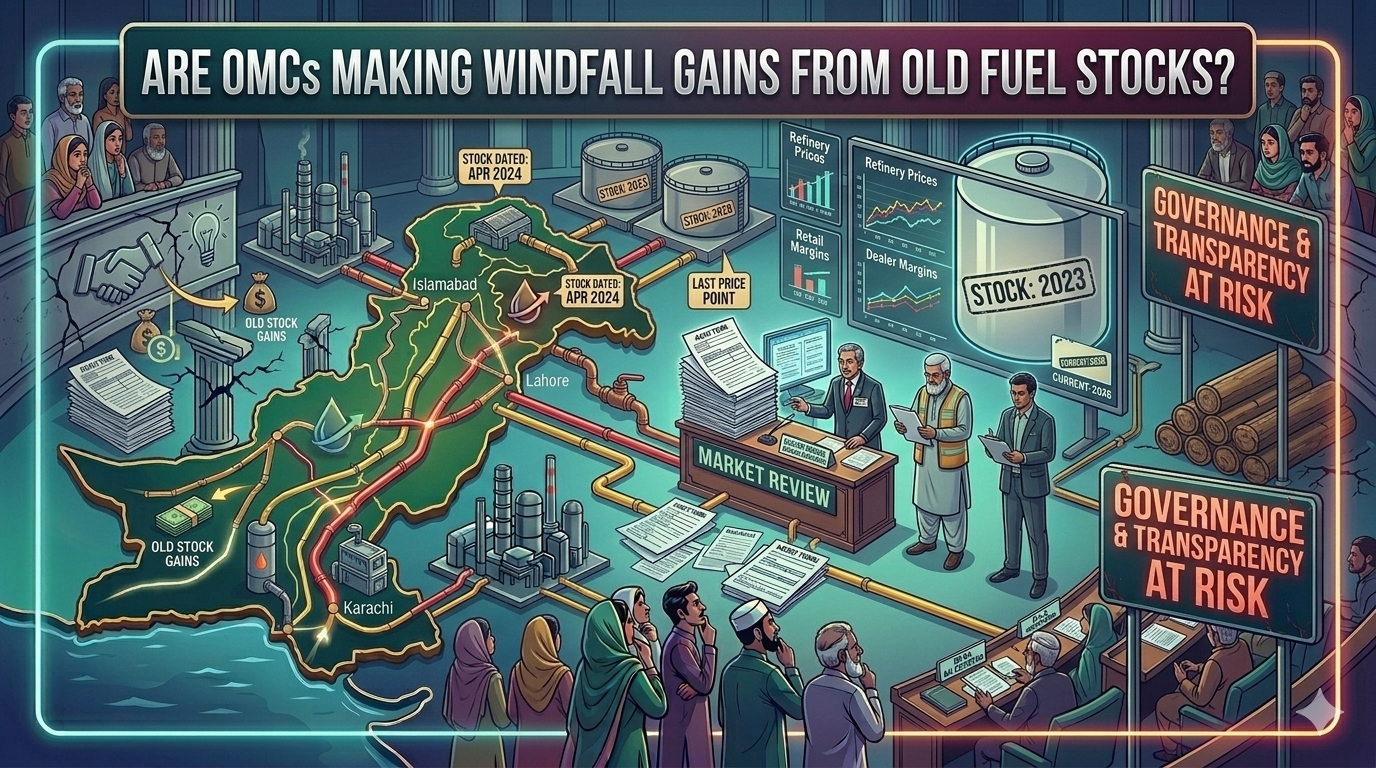
Following the recent increase in petrol and diesel prices in Pakistan, a debate has intensified over whether the government or oil companies are earning billions through so-called “inventory profits” by selling previously purchased cheaper fuel at higher prices.
The question has gained traction on social media and in some economic circles, where it is argued that if Pakistan imported oil at lower prices weeks earlier, selling it today at higher retail prices should generate massive “inventory profits.”
At first glance, the argument appears logical. However, it largely stems from a misunderstanding of how Pakistan’s petroleum pricing system and global oil supply chain actually work.
To understand the issue, it is important to look at how fuel prices are determined and how oil inventories operate in practice.
First, petrol and diesel prices in Pakistan are not determined based on the cost of a single shipment or the price at which a particular cargo was purchased weeks earlier. Instead, the government calculates domestic fuel prices using the average international benchmark prices published by S&P Global Commodity Insights (Platts) during the pricing period.
These benchmark prices reflect the prevailing international market value of petroleum products. The government then adjusts them by incorporating factors such as the exchange rate, freight and shipping costs, taxes, petroleum levy, and marketing margins before determining the final retail price.
For example, the prices announced on March 1 were based on the global market trend prevailing at that time. The average international price of diesel was around $88 per barrel, while petrol was roughly $78 per barrel.
However, within days the situation in global energy markets changed dramatically due to rising geopolitical tensions in the Middle East. By March 6, international diesel prices had surged to over $149 per barrel, while petrol climbed to around $106 per barrel.
Another critical factor often overlooked in the public debate is the time lag in oil procurement and transportation.
Oil cargoes are not delivered instantly. For instance, shipments from the Saudi port city of Yanbu typically take around 20 days to reach Pakistan. This means that the oil being purchased today will arrive weeks later, and its cost reflects the prevailing international prices at the time of purchase.
If the government were to keep domestic prices artificially low by relying only on older cheaper inventory, a major distortion could emerge in the supply chain. Refineries and oil marketing companies would hesitate to purchase expensive crude or refined products because they might not be able to recover their costs through regulated prices.
Such a situation could eventually disrupt fuel supply and even worsen the energy sector’s long-standing problem of circular debt.
Another key aspect is Pakistan’s regulatory requirement for oil companies to maintain mandatory fuel stocks of around 20 days to ensure uninterrupted supply across the country. In the current regional security environment, companies may even maintain higher inventory levels.
This means oil companies are constantly operating in a continuous replenishment cycle. While fuel is being sold to consumers from existing stocks, companies simultaneously purchase new cargoes from international markets to replenish the inventory.
As a result, when a litre of petrol is sold today, it must effectively be replaced with another litre purchased at current global prices in order to maintain the mandatory stock requirement. Because the inventory is continuously replenished, any apparent “inventory gain” is largely neutralized by the higher cost of replacement fuel.
In reality, the opposite scenario occurs quite frequently.
When international oil prices decline, the government reduces domestic fuel prices in line with the pricing formula. However, oil companies may still be holding inventory that was purchased earlier at higher international prices.
In such cases, refineries and oil marketing companies are forced to sell higher-cost fuel at lower regulated prices, resulting in significant inventory losses.
For example, in December, petrol prices in Pakistan were reduced by around Rs24 per litre following a decline in global oil prices. At that time, refineries and oil marketing companies were holding stocks purchased at higher prices, forcing them to sell the fuel at lower rates and absorb billions of rupees in losses.
Similar situations were observed in 2022 and 2023, when multiple fuel price reductions compelled companies to sell higher-cost inventories at lower retail prices.
This is why in the global energy business, inventory gains and inventory losses are both normal outcomes of price volatility. Sometimes rising prices create a temporary gain, but falling prices often result in equally large losses.
According to Petroleum Minister Ali Pervaiz Malik, the current global energy environment is highly uncertain. Rising geopolitical tensions in the Middle East have significantly disrupted oil markets, leading to sharp fluctuations in international prices.
In such circumstances, aligning domestic fuel prices with global trends is essential to maintain supply stability and prevent artificial shortages or hoarding in the market.
The government maintains that its primary priority is ensuring uninterrupted fuel availability and maintaining economic stability. Artificially suppressing prices could discourage imports, strain the supply chain, and deepen the financial challenges facing the energy sector.
Ultimately, global energy markets are highly volatile and sensitive to geopolitical developments. Pricing decisions therefore cannot be based solely on past purchase costs but must account for future supply requirements and the overall stability of the energy system.
For this reason, experts argue that the current debate over “inventory profits” should be viewed through the lens of market realities rather than assumptions about cheap oil bought in the past.
