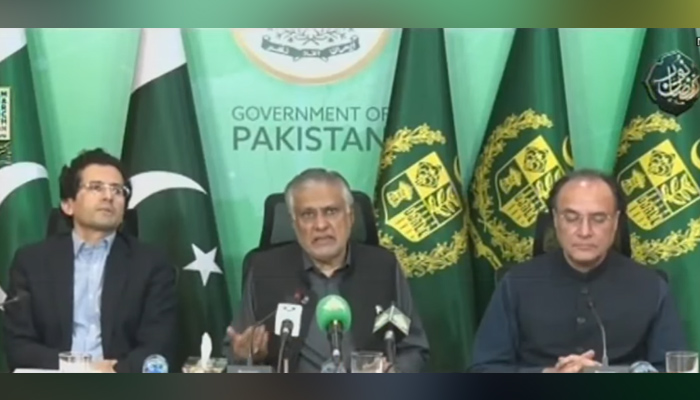
The government has announced a massive increase of Rs55 per litre in the prices of petrol and high-speed diesel, citing rapidly rising international oil prices amid escalating tensions in the Middle East.
Following the increase, the price of petrol has been fixed at Rs321.17 per litre, while the price of high-speed diesel has risen to Rs335.86 per litre. The revised prices came into effect immediately after midnight.
The announcement was made during a joint press conference by Deputy Prime Minister and Foreign Minister Ishaq Dar, Finance Minister Muhammad Aurangzeb, and Petroleum Minister Ali Pervaiz Malik.
Industry sources said the increase was driven by sharp volatility in global oil markets triggered by heightened tensions in the Middle East, which have pushed international petroleum prices significantly higher.
As part of the revision, the petroleum development levy on petrol has been increased from Rs84.40 per litre to Rs105 per litre. However, the levy on high-speed diesel has been reduced from Rs76.21 per litre to Rs55 per litre.
Speaking at the press conference, Ishaq Dar said the region was facing an extraordinary situation due to ongoing conflict and geopolitical tensions.
He said international petroleum prices were rising rapidly and the government had been reviewing the situation on a daily basis. According to Dar, Prime Minister Shehbaz Sharif personally chaired a meeting earlier in the day to assess the evolving energy and economic situation.
Dar said the government had attempted to strike a balance while deciding the price increase, noting that authorities were also engaging diplomatically with several countries to help reduce tensions in the region.
“We are witnessing a war-like situation in the region and petroleum prices are skyrocketing globally,” he said, adding that Pakistan was closely coordinating with friendly countries in an effort to help ease tensions.
The deputy prime minister said the government had been reviewing the market developments for the past five days and that prices were rising sharply every day.
Petroleum Minister Ali Pervaiz Malik said Pakistan was facing “extraordinary circumstances” as the regional situation had begun affecting the entire energy market.
He said the government had already taken precautionary steps by increasing petroleum product reserves in anticipation of possible supply disruptions.
Malik acknowledged that the price increase was a difficult decision but said it had been taken out of necessity given the international market dynamics.
He added that once global conditions stabilize, the government would move quickly to reduce petroleum prices.
The minister also announced that the government would review petroleum product prices on a weekly basis instead of the current fortnightly review to respond more quickly to international market fluctuations.
Impact on Consumers
The steep increase in fuel prices is expected to have a wide-ranging impact on consumers and the broader economy, as petrol is primarily used by private transport and motorcycles while high-speed diesel fuels public transport, agriculture machinery, and goods transportation.
Economists warn that the sharp rise in diesel prices in particular could increase transportation costs, potentially leading to higher prices of essential food items, vegetables, and other consumer goods across the country.
Transporters and logistics operators are also expected to revise freight and fare charges in response to the higher fuel costs, which could further add to inflationary pressures already affecting households.
The fuel price shock comes at a time when many consumers are already struggling with high electricity tariffs and rising living costs, increasing concerns about another wave of inflation in the coming weeks.
