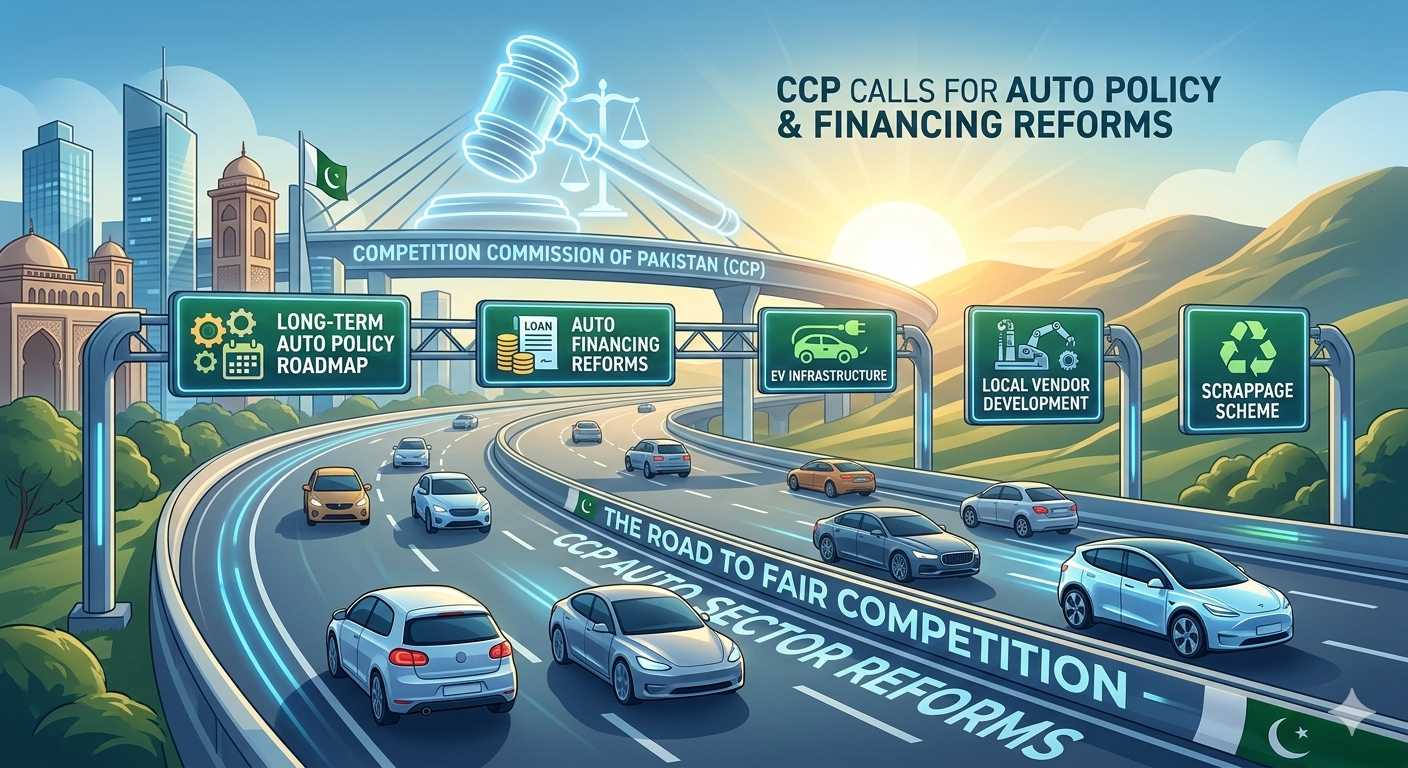
The Competition Commission of Pakistan (CCP) has flagged deep-rooted structural distortions in Pakistan’s automobile industry and proposed sweeping reforms, including tariff rationalization, easier auto financing, and a clear long-term electric vehicle roadmap to foster genuine competition.
In a comprehensive report titled “The Road to Fair Competition – A Study of Pakistan’s Automobile Industry,” the Commission highlighted that despite multiple auto policies over the years, the passenger car market remains concentrated across several engine categories due to high entry barriers, capital-intensive requirements, and complex regulatory structures.
The automobile sector contributes around 2.8 percent to Pakistan’s GDP and directly employs more than 215,000 people. As a major component of Large-Scale Manufacturing, it plays a significant role in industrial growth, technology transfer, and domestic value addition, particularly in the passenger car segment, including emerging electric vehicles (EVs).
However, the CCP observed that while protectionist policies historically helped establish domestic manufacturing, prolonged tariff protections and localization requirements have not consistently translated into competitive outcomes or export-led growth. The study notes that regulatory fragmentation and overlapping institutional mandates have further complicated investment decisions and policy consistency.
According to the report, earlier auto policies sought to attract new entrants, promote localization, and boost exports, but structural rigidities, policy reversals, and weak implementation diluted their intended impact. As a result, market concentration persists in key engine categories, limiting consumer choice and competitive pricing.
To address affordability constraints, the CCP has recommended expanding access to vehicle financing by reviewing restrictive auto loan limits and introducing targeted, subsidized schemes for first-time buyers in coordination with financial regulators. The Commission believes such measures could stimulate demand and broaden market participation.
On electric vehicles, the study stressed the importance of a predictable and coordinated policy transition. It pointed out that inadequate charging infrastructure, limited domestic EV production capacity, and reliance on fossil fuel-based electricity remain major barriers to large-scale adoption. Sustained policy consistency and infrastructure investment will be critical to attract long-term private capital into the EV ecosystem.
The report also highlighted the absence of a comprehensive vehicle scrappage and phase-out framework. It recommended introducing a structured disposal policy to remove obsolete and high-emission vehicles, improve road safety, address environmental concerns, and generate replacement demand in the auto market.
To strengthen industrial linkages, the CCP called for transparent and non-discriminatory localization policies aimed at developing domestic vendors and integrating Pakistan’s automobile sector into global supply chains.
For a level playing field, the Commission recommended gradual rationalization of distortive protections, removal of regulatory asymmetries, and adoption of stable, pro-competition policies designed to encourage investment, innovation, and efficiency.
The CCP noted that a genuinely competitive automobile industry could deliver significant benefits to consumers and the broader economy, including lower prices, better quality vehicles, greater product choice, and enhanced export potential.
The Commission expressed hope that the study will guide policymakers, regulators, and industry stakeholders in shaping a modern, competitive, and globally integrated automobile sector. The report has been uploaded on the CCP’s website for public comments and suggestions.
