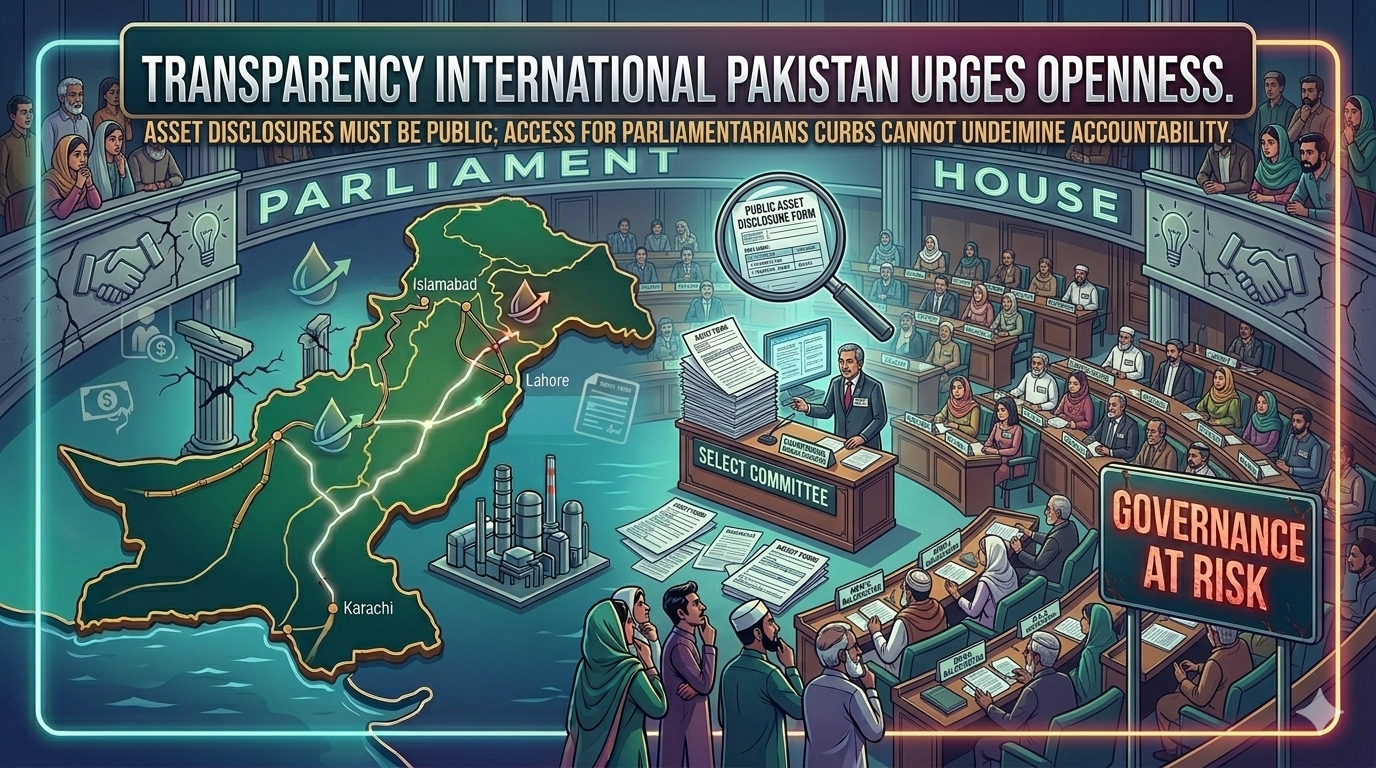
Transparency International Pakistan has urged the president, federal government, and lawmakers to refrain from restricting public access to asset declarations of parliamentarians, warning that such a move could undermine political integrity and legislative transparency.
In a statement, the organization said the proposed Elections (Amendment) Bill, 2026—introduced in the National Assembly of Pakistan—seeks to limit public access to asset disclosures of lawmakers, a mechanism it described as essential for ensuring accountability and public oversight.
Transparency International Pakistan noted that Sections 137 and 138 of the Elections Act, 2017 currently serve as a critical transparency mechanism, enabling citizens to review financial declarations of elected representatives in line with global best practices on legislative accountability.
However, it warned that the proposed amendments could weaken this oversight framework by restricting access to information about the financial interests of public office holders.
The organization also pointed out that the proposed changes contradict reforms undertaken by Pakistan following recommendations in the IMF Governance and Corruption Diagnostic Report on Pakistan.
According to TI Pakistan, one of the 15 key benchmarks of the report focuses on improving the integrity of senior public officials by ensuring the public disclosure of asset declarations.
Pakistan has already taken steps in that direction through the passage of the Civil Servants (Amendment) Bill, 2025 by the Senate of Pakistan, which requires civil servants from BPS-17 to BPS-22 to publicly declare both domestic and foreign assets, including those held by immediate family members.
The organization cautioned that restricting asset disclosures for parliamentarians while expanding transparency requirements for senior civil servants would create an uneven accountability framework, where the executive branch is subject to stricter transparency standards than the legislative branch.
Transparency International Pakistan further warned that the move could negatively affect the country’s performance on the Corruption Perceptions Index published annually by Transparency International.
It noted that accountability of public office holders is a key factor across the eight international data sources used to calculate Pakistan’s CPI score.
The organization also highlighted that limiting disclosure requirements could contradict Pakistan’s commitments under the United Nations Convention against Corruption, which emphasizes public asset declarations as an important safeguard against conflicts of interest and illicit enrichment.
Transparency International Pakistan has called for the proposed bill to be withdrawn to ensure that a robust legal framework governing the asset disclosures of parliamentarians remains in place in accordance with international transparency standards.
