Staff Report
ISLAMABAD:
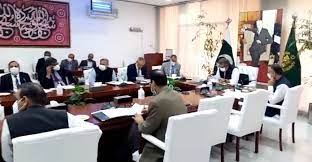
Cabinet Committee on Transport and Logistics (CCoTL) has sought report from various ministries to compensate above Rs 100 billion annual burdens on the masses and mulling measures to ensure uninterrupted supply of petroleum products in the country.
According to sources, the Cabinet Committee on Transport and Logistics (CCoTL) while acting on the advice of Prime Minister Imran Khan to compensate masses of more than Rs 100 billion annual heavy burdens per annum due to expansive energy and to take necessary measures to ensure uninterrupted supply of petroleum products has directed Petroleum Division and Ministry of Maritime Affairs to initiate work immediately on development of a Single Point Mooring (SPM) Policy in consultation with all stakeholders which will be similar to the Byco policy. The CCoTL has also directed Petroleum Division to make presentation on collection of deemed duty on high speed diesel (HSD) from last 16 years by the oil refineries and collection of Inland Freight Equalization Margin (IFEM) by the oil marketing companies (OMCs) while customs duty on Liquefied Natural Gas (LNG) and collection of Un-accounted for Gas (UfG) by Sui Northern and Southern Gas Companies.
Available documents with this scribe disclosed that the CCoTL has started review on transport charges of Re-gasified Liquefied Natural Gas (RLNG) in accordance with the direction of federal cabinet issued on 13th April, 2021 and directed Petroleum Division and Ministry of Maritime Affairs to initiate work immediately on development of a Single Point Mooring (SPM) Policy for off-loading of crude oil and petroleum products in the deep sea instead of on ports.
Byco Group has the largest refining capacity of 155,000 barrels per day and to feed Pakistan’s largest refining complex as the company made operational its SPM in 2013 and due to this system the offloading of 2 lakh ton oil carrying vessel in deep sea made possible. Similarly, reduction of traffic on port and control on billion rupees annual demurrages charges to provide relief to consumers of petroleum products have been made possible with this system (SPM). Furthermore, petroleum division has been directed to submit report regarding approved deemed duty of the refineries, and IFEM of the OMCs.
Sources said that oil refineries had collected approximately Rs 300 billion as deemed duty on HSD while the aim of imposing the deemed duty was the up-gradation of the refineries. However, they said that the refineries had used deemed duty to reduce their losses. They said the CCoTL would also review whether the aim of imposing deemed duty was achieved or not. They said it would also be reviewed by CCoTL that an end to 7.5percent deemed duty on HSD should be made or not to provide relief to the masses. They said the CCoTL would also review IFEM to maintain same prices of petroleum products at 22 oil depot of the country. They said OMCs and petroleum dealers, in the past, had been causing billion rupees losses to the national exchequer by dumping the petroleum products and due to this, several oil depots were closed. CCoTL will further review the collection of IFEM in a bid to provide relief to masses and collection of billion of rupees by SNGPL and SSGCL under the head UfG from the gas consumers, said sources.
The sources further said that CCoTL after reviewing above said issues has decided to constitute a committee under the Chairmanship of Secretary, Finance Division, consisting of Secretary Petroleum Division, Secretary Ministry of Maritime Affairs, Chairman OGRA and Chairman PQA and this committee would deliberate on the issue of reduction of RLNG price while petroleum division during the next meeting of CCoTL will give before CCoTL on the subject of Un-Accounted for Gas (UFG); the FBR on custom duty being charged on hydrocarbons (Petroleum products) import; on PSO/PLL margins and Port Qasim/KPT on how hydrocarbon duties are being collected. Petroleum Division was also directed to make presentation on deemed duty allowed to oil refineries and on Inland Freight Equalization Margin (IFEM) to the CCoTL in next meeting, said sources.
It is also learnt from sources that Cabinet Committee on Energy (CCoE) in its meeting on 4-3-2021 (ratified by the Federal Cabinet) had directed the Ministry of Maritime Affairs to examine the case regarding imposition of GST on Channel Development Cess (CDC) by the Government of Sindh, with a view to challenge the same in a court of law as done by the Civil Aviation Authority in a similar case in the Sindh High Court. While the decision stands ratified, the Ministry of Maritime Affairs was directed to make presentation on status of the case regarding imposition of Sindh Infrastructure Cess on the import of Petroleum Products.
Sources further told that CCoTL had also constituted a committee under the Chairmanship of Secretary, Ministry of Maritime Affairs consisting of the Secretary Petroleum Division, Chairman PQA and Chairman KPT to see if the waiver of Channel Development Cess (CDC) has been passed on to the end consumers or otherwise. And, Oil and Gas Regulatory Authority (OGRA) will submit report to the CCoTL in this regard.
It is pertinent to mention that Byco has achieved historic milestone by establishing the country’s first and only deep sea Single Point Mooring (SPM) facility. Byco Terminals Pakistan Limited (BTPL) is a wholly owned subsidiary of Byco Petroleum Pakistan Limited. Byco Group has the largest refining capacity of 155,000 barrels per day and to feed Pakistan’s largest refining complex, the company initiated development of country’s first Single Point Mooring (SPM) facility for offloading Crude oil and petroleum products with the help of a world renowned port facility development company China Harbour Engineering Company Ltd (CHEC). The SPM has been set up in the North Arabian Sea at a distance of approximately 14 km from the Byco’s Mouza Kund Site located at Hub, Balochistan and is approximately 10 kilometers inside the sea at 25 meters depth. The SPM is connected to the storage tanks through a 28 inch diameter offshore and onshore pipeline. The SPM can handle crude oil tankers of over 200,000 tons deadweight, which has resulted in freight economics and contributed to enhance Byco refineries operation and reduced demurrage.
