Monitoring Desk
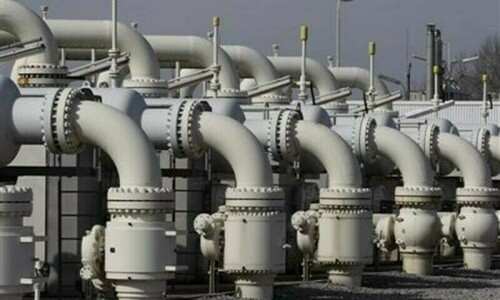
ISLAMABAD: In a bid to meet IMF conditions for the release of $1.1 billion in bailout funds, the government has significantly raised gas tariffs for industrial captive power plants (CPPs) by 23% and abandoned plans for major electricity rate cuts.
The move comes as part of broader fiscal reforms demanded by the International Monetary Fund (IMF) to address economic imbalances and ensure sustainable energy pricing.
A senior official involved in the negotiations confirmed to a private media outlet that the IMF team, led by Nathan Porter, maintained a tough stance on imposing a ‘grid levy’ on natural gas and liquefied natural gas (LNG) supplied to industrial CPPs. Consequently, the government swiftly formalized a Rs791 per million British thermal unit (mmBtu) grid levy, effective from March 7, 2025, and shared the notification with IMF staff.
Petroleum Secretary Momin Agha issued the notification under the Off-Grid (Captive Power Plants) Levy Ordinance, 2025, raising the total gas price for CPPs to Rs4,291 per mmBtu, following an earlier Rs500 hike. However, the levy will progressively increase, reaching nearly Rs6,000 per mmBtu by August 2026, to encourage industries to transition to the national power grid.
Officials revealed that the IMF opposed proposals for an Rs8-10 per unit electricity tariff cut via reduced sales tax, citing substantial fiscal implications. However, a limited reduction of Rs2-2.5 per unit may be feasible by July, supported by revenue from the grid levy, power purchase agreement adjustments, lower interest payments, and exchange rate stability.
Despite prior government resistance to the grid levy, the policy was ultimately enforced under commitments made in the $7 billion Extended Fund Facility (EFF) agreement. Officials had previously hinted at substantial electricity rate reductions and an extended winter relief package for industries, which now seem unlikely.
Meanwhile, Deputy Prime Minister Ishaq Dar reviewed discussions on the IMF’s Resilience & Sustainability Facility (RSF), reaffirming Pakistan’s commitment to climate adaptation and mitigation efforts. The country has formally requested over $1.2 billion under the RSF, designated for climate-vulnerable nations.
The IMF has also raised concerns over the slow privatization of power distribution companies (Discos) and their financial losses. The government plans to divest shares in Islamabad, Faisalabad, and Gujranwala Discos in the first phase, followed by those in Multan, Lahore, and Hyderabad.
Under the Off-Grid Levy Ordinance, the collected revenue will be used to subsidize electricity tariffs for other consumers. Authorities must calculate levy rates based on the disparity between Nepra-notified industrial power tariffs and self-generation costs of CPPs at the Ogra-notified gas tariff. Non-payment of the levy will lead to gas supply termination for defaulting plants.
IMF officials are now focusing on the enforcement of agricultural income tax collection from July 1, 2025, engaging both federal and provincial governments on the matter. Additionally, the review process includes discussions on taxation for the retail and real estate sectors.
Sources claim Pakistan has broadly met its economic targets for the end-December 2024 period, though some benchmarks are experiencing delays. Given the timing of the first biannual review, forward-looking policy discussions are also shaping next year’s budget, which is expected in early June. The budget will undergo IMF scrutiny before finalization, including virtual consultations beyond the current talks.
The policy discussions also cover governance reforms, such as the development of a new portal for the public disclosure of tax returns and asset declarations of government officials. A wrap-up meeting with Finance Minister Muhammad Aurangzeb is scheduled for Friday, marking the conclusion of the current round of negotiations.
