Staff Report
ISLAMABAD: The federal government has withdrawn subsidy on gas to five export-oriented sectors, including the textile, sports, surgical, leather, and jute sectors effective from May 1, 2023.
The Sui Northern Gas Pipelines Limited (SNGPL) has informed its noble customers about the end of the supply of subsidized gas to these sectors.
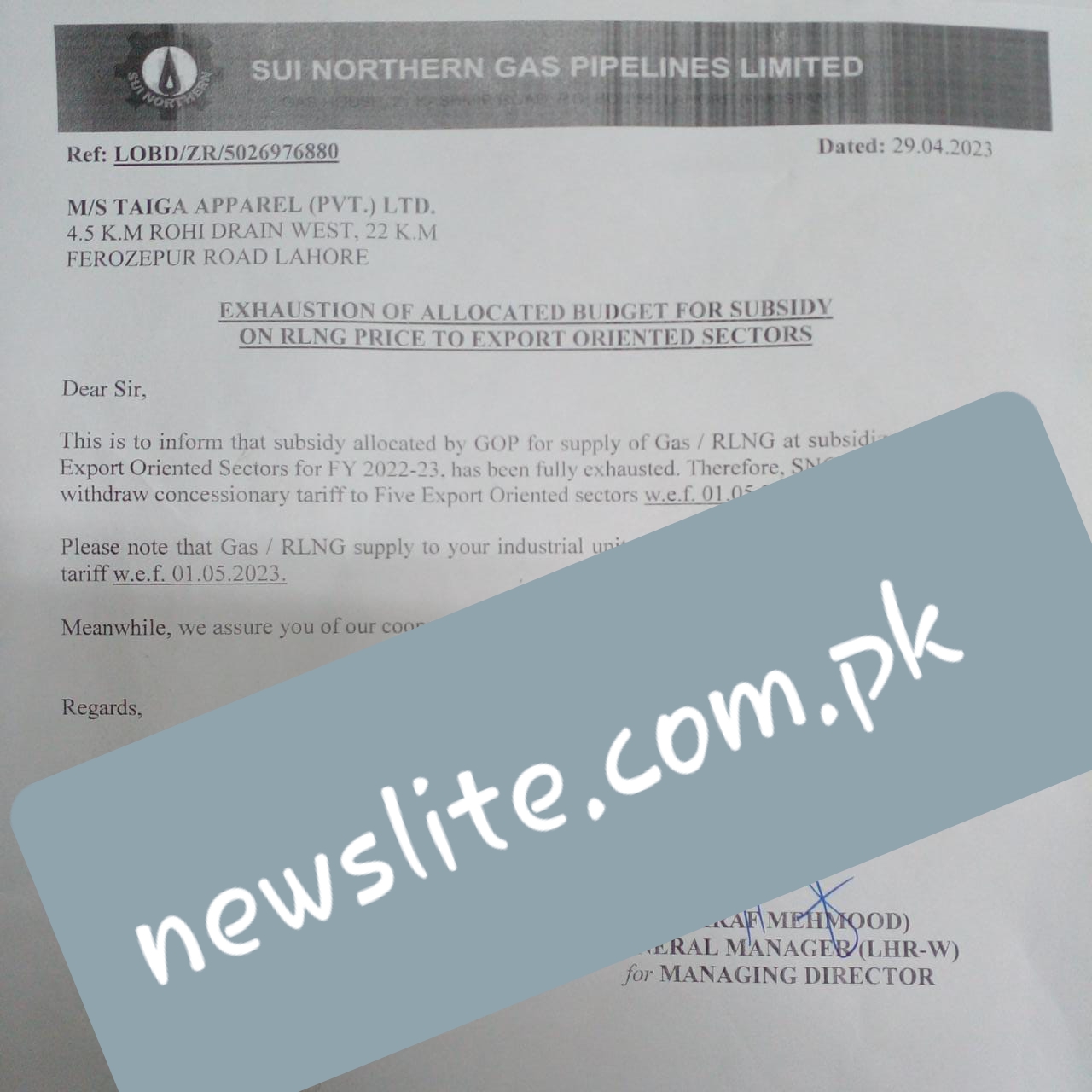
SNGPL, in a letter dated 29th April, 2023 to a customer, informed that subsidy allocated by the government for supply of gas/Re-gasified Liquefied Natural Gas (RLNG) at subsidized rate to five export-oriented sectors for financial year (FY) 2022-23 has been fully exhausted.
Therefore, the SNGPL is constrained to withdraw concessionary tariff to five export-oriented sectors with effect from 01-05-2023, said SNGPL letter carrying subject “Exhaustion of Allocated Budgeted Subsidy on RLNG Price to Export Oriented Sectors” dated 29-04-2023.
“Please not that Gas/RLNG supply to your industrial units shall remain available at OGRA notified tariff w.e.f 01-05-2023,” reads SNGPL letter.
According to sources, the supply of re-gasified liquefied natural gas (RLNG) to these sectors will end at $9, and they will have to pay an additional $4 per mmbtu on supply of RLNG with the start of May 2023. The government has taken this decision on the continuous demand of the International Monetary Fund (IMF) to end subsidies. The National Electric Power Regulatory Authority (NEPRA) also approved the federal government’s decision to withdraw concessional tariffs of five export-oriented sectors and agriculture tubewells from March 1, 2023.
The export-oriented sectors, including the textile industry, have been facing criticism from different quarters over getting subsidized gas and electricity at the same time. These sectors had been receiving electricity and gas at discounted rates at the same time. The previous government linked the provision of gas to the textile units with the performance audit of the captive power plants.
The government’s decision to withdraw subsidized gas tariffs to the export-oriented sectors will help reduce the burden on the national exchequer. However, it remains to be seen how these sectors will cope with the increased costs and maintain their competitiveness in the global market.
The petroleum division conducted a study explaining that while sales from textile mills had increased locally, there had not been a substantial increase in textile exports. There had been a misuse of the gas subsidy provided to the captive power plants as those textile units were also receiving subsidized gas.
This decision is a bold step towards rationalizing energy prices and ensuring that sectors do not receive undue benefits at the expense of others. It will be interesting to see how these sectors will adjust to the increased costs and remain competitive in the global market.
