Iranian President Dr. Masoud Pezeshkian concluded his one-day visit to Pakistan on Tuesday after holding meetings with Pakistan’s top civilian and military leadership and expressing appreciation for Islamabad’s efforts to promote dialogue and de-escalation in the region.
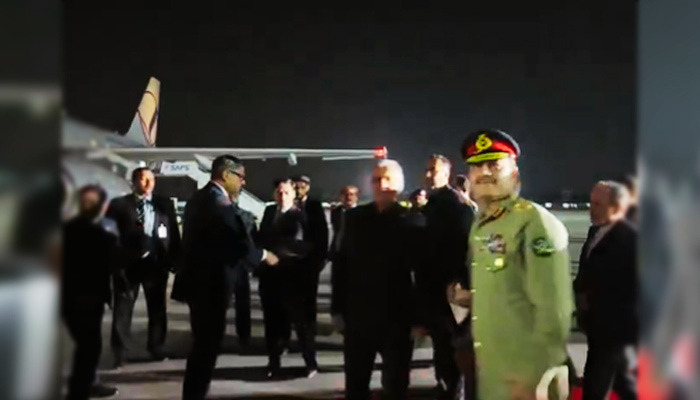
Field Marshal Syed Asim Munir, Deputy Prime Minister and Foreign Minister Ishaq Dar, and senior Pakistani officials saw off the Iranian president at the conclusion of his visit. During the farewell ceremony, President Pezeshkian was also presented with an album containing photographs from his visit.
The Iranian president arrived in Islamabad earlier in the day, where his aircraft landed at Nur Khan Airbase. He was received by President Asif Ali Zardari, Prime Minister Shehbaz Sharif, and Deputy Prime Minister Ishaq Dar.
During the visit, President Pezeshkian held separate meetings with President Zardari and Prime Minister Shehbaz Sharif to discuss bilateral relations and matters of mutual interest.
The Iranian leader also met Field Marshal Syed Asim Munir during his stay in Islamabad.
At the Prime Minister’s House, President Pezeshkian was accorded a guard of honour by a smartly turned-out contingent of the armed forces. He inspected the guard of honour, while the national anthems of Pakistan and Iran were played.
Prime Minister Shehbaz Sharif introduced members of the federal cabinet to the visiting dignitary, while President Pezeshkian introduced members of his delegation to the Pakistani premier.
The two leaders also planted a sapling in the lawn of the Prime Minister’s House as a symbol of friendship and cooperation between the two neighbouring countries.
According to official sources, the visit was aimed at acknowledging Pakistan’s efforts to encourage dialogue between the United States and Iran. During his meetings, President Pezeshkian thanked Prime Minister Shehbaz Sharif for Pakistan’s constructive role and diplomatic efforts in promoting engagement and mediation.
The visit underscored the importance both countries attach to strengthening bilateral relations and maintaining close coordination on regional and international issues.
