Monitoring Desk
ISLAMABAD:
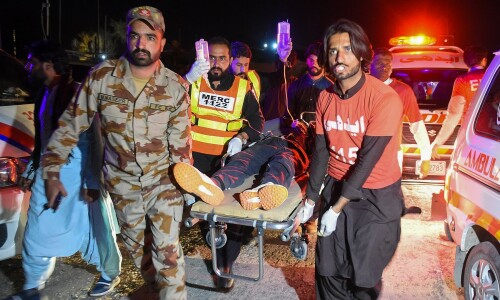
The Jaffar Express hostage crisis in Balochistan concluded on Wednesday night after a decisive military operation freed all passengers held captive by terrorists. The Pakistan Army, in coordination with the Air Force, Frontier Corps, and Special Services Group (SSG), successfully neutralized 33 militants in the operation.
Inter-Services Public Relations (ISPR) Director General Lt Gen Ahmed Sharif Chaudhry and Federal Minister for Information Attaullah Tarar confirmed the successful completion of the rescue mission in separate announcements. Lt Gen Sharif stated that all remaining hostages were safely evacuated from the train, which had been stranded near the Mashkaf Tunnel in the Bolan range.
The Jaffar Express, carrying around 440 passengers, was hijacked by terrorists who used women and children as human shields, making the rescue operation highly complex. Though Lt Gen Sharif did not specify the exact number of hostages freed, security officials said the operation was carried out in multiple phases. More than 100 hostages were rescued in the first phase, followed by 80 more who were transported to Mach in the second phase. Additionally, around a dozen passengers, including two railway policemen, managed to escape on their own and reached Quetta safely.
Despite the successful rescue, the attack resulted in significant casualties. According to ISPR, 21 passengers lost their lives, while four Frontier Corps personnel were martyred.
Precision Military Operation
Lt Gen Sharif described the operation as one of the most challenging counterterrorism missions due to the difficult terrain, limited access, and the presence of heavily armed militants. The security forces devised a tactical approach to ensure the safety of hostages while eliminating the terrorists.
Drone footage released by ISPR showed three separate groups of hostages huddled near the train under the watch of suicide bombers. Snipers from the SSG commandos strategically took out these bombers, allowing security forces to move in and free the captives.
A senior security official revealed that as the rescue team advanced, a fierce gun battle ensued, leading to the final elimination of the remaining terrorists. The operation’s success was attributed to the coordinated efforts of the army, air force, and intelligence agencies.
“These terrorists were in direct communication with their handlers in Afghanistan via satellite phone during the entire operation,” Lt Gen Sharif disclosed, highlighting the external links of the attackers. He emphasized that the militants had no connection to Balochistan or religious extremism. “This incident has changed the rules of the game,” he remarked, underscoring the evolving security threats facing Pakistan.
Disinformation and External Influence
Lt Gen Sharif strongly condemned the spread of misinformation on social media, particularly from Indian sources, which he claimed exposed the direct involvement of external elements in fueling terrorism.
Federal Minister Attaullah Tarar also denounced the Indian media for distorting facts and attempting to manipulate the narrative. He criticized certain political figures for using the tragic incident for their own interests instead of standing with the state.
“The language of some opposition leaders aligns disturbingly with the rhetoric of the banned Balochistan Liberation Army (BLA) and Indian media,” Tarar stated, hinting at deliberate attempts to mislead the public. “Unfortunately, some individuals are prioritizing political ambitions over national security,” he added.
With the hostage crisis resolved, security forces have now entered the clearance phase, conducting bogie-to-bogie searches and securing the surrounding areas. Efforts are also underway to bring back passengers who fled into the rugged terrain during the operation.
The swift and successful conclusion of the crisis marks a significant counterterrorism victory for Pakistan’s security forces while raising serious concerns about regional security threats and foreign involvement in militant activities.
