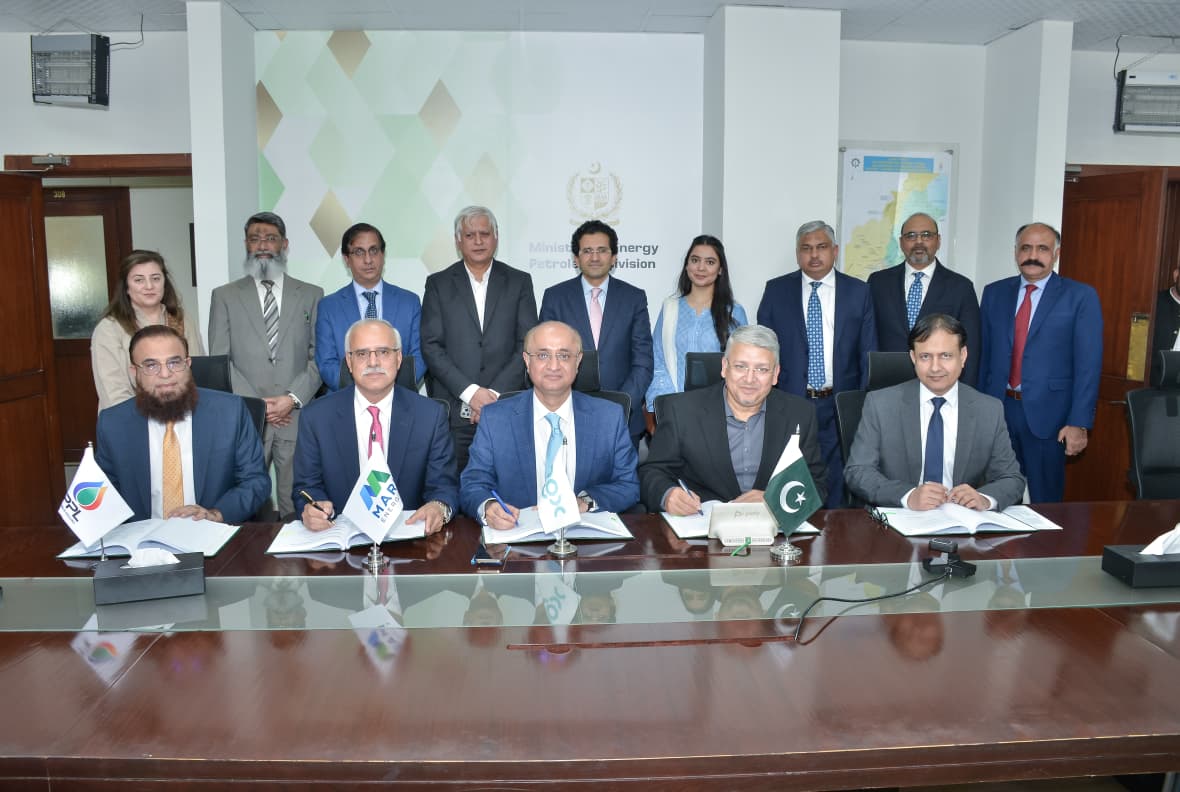
Pakistan has taken a major step toward boosting domestic hydrocarbon production by awarding 11 onshore exploration blocks under new concession agreements, targeting enhanced oil and gas discovery potential while attracting upstream investment.
The agreements were signed by the Government of Pakistan through the Petroleum Division (Pakistan), marking a fresh push to accelerate indigenous energy development and reduce import dependence.
The awarded blocks are distributed across three provinces, including eight blocks in Balochistan (Pakistan), two in Sindh (Pakistan), and one in Punjab (Pakistan), reflecting a strategy to explore geographically diverse hydrocarbon prospects.
The successful joint venture partners include Oil and Gas Development Company Limited, Pakistan Petroleum Limited, Mari Petroleum Company Limited, Pakistan Oilfields Limited, and Prime Global Energies.
Officials said the minimum committed investment exceeds $31 million (approximately Rs8.66 billion), which will be deployed over the next three years for seismic surveys, exploratory drilling, and other upstream exploration activities.
In addition, about Rs276 million has been committed toward social welfare programmes in the concession areas to support community development, infrastructure improvement, and local engagement initiatives.
The operating structure assigns six blocks to MariEnergies as operator, including full working interest in Padag, Chagai, Dalbandin, Merui, and Merui West blocks, while the Ahmad Wal block will be developed jointly with Oil and Gas Development Company Limited.
OGDCL will also operate Kalat North with 100% working interest and participate in joint ventures in Naing Sharif and Khiu-II blocks alongside Prime Global Energies and MariEnergies.
Meanwhile, Pakistan Petroleum Limited secured the Kalat South block as highest bidder, and Pakistan Oilfields Limited obtained full working interest in the Jherruk block.
Authorities said successful commercial discoveries could trigger additional multimillion-dollar investments for field development and production, potentially generating employment, stimulating regional economic growth, and reducing energy import pressure.
The government reaffirmed its commitment to maintaining a stable regulatory and investment-friendly environment to promote sustainable development of the country’s indigenous energy resources.
