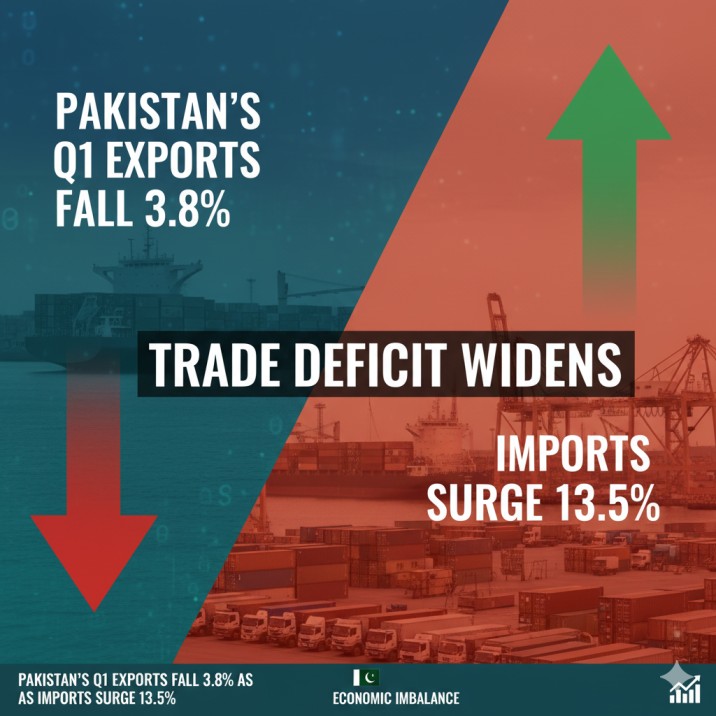
Pakistan’s exports fell by 3.83 percent year-on-year (YoY) to $7.60 billion in the first quarter of the ongoing fiscal year (FY26), while imports surged, widening the country’s trade deficit.
According to provisional data released by the Pakistan Bureau of Statistics (PBS), exports stood at $7.60 billion during July–September FY26, down from $7.91 billion in the same period last year. In contrast, imports rose by 13.49 percent, reaching $16.97 billion compared to $14.95 billion in Q1 FY25.
This imbalance pushed the quarterly trade deficit sharply higher.
September Snapshot
In September alone, exports dropped by 11.71 percent YoY to $2.50 billion, down from $2.84 billion in the same month last year. Imports, however, climbed to $5.84 billion, compared to $5.13 billion a year earlier. As a result, the trade deficit widened to $3.34 billion, a jump of 45.83 percent YoY.
On a month-on-month (MoM) basis, exports showed a modest increase of 3.64 percent compared to August’s $2.42 billion, while imports rose 10.53 percent from $5.29 billion. Consequently, the monthly trade deficit grew 16.33 percent MoM.
Textile Sector Under Pressure
The export slump was largely driven by a decline in textile shipments, which account for nearly 60 percent of Pakistan’s total export earnings.
Former All Pakistan Textile Mills Association (APTMA) chairman Asif Inam said falling global cotton prices and high domestic energy costs have hurt competitiveness.
“Over the past year, cotton prices have declined from $1.50 to 64 cents per pound, squeezing profit margins for textile exporters,” he said.
He added that if exporters were provided electricity at 7 cents per unit instead of the current 12–13 cents, textile exports could potentially reach $25 billion within two to three years.
Services Trade
Meanwhile, PBS data showed services exports increased 11.73 percent to $1.4 billion during July–August FY26, compared to $1.25 billion a year earlier. Services imports, however, rose faster, climbing 15.37 percent to $2.1 billion from $1.85 billion.
This pushed the services trade deficit to $707 million, up 16.94 percent from $604.8 million in the corresponding period last year.
Outlook
The widening trade deficit highlights ongoing challenges for Pakistan’s external sector, with export sluggishness and rising imports creating fresh pressure on the country’s balance of payments. Analysts warn that unless structural bottlenecks—particularly in the textile sector—are addressed, Pakistan may continue to face difficulty in boosting export earnings.
