Staff Report
ISLAMABAD: The Permanent Court of Arbitration (PCA) in The Hague is set to hear Pakistan’s request on July 5, 2024 concerning the construction of the contentious Kishanganga and Ratle hydroelectric projects on the Chenab and Neelam rivers in Indian Illegally Occupied Jammu and Kashmir (IIoJK).
A Pakistani delegation, led by Secretary Water Resources Syed Ali Murtaza and including Indus Water Commissioner Mehar Ali Shah and legal experts, had previously inspected these sites with neutral experts and PCA judges in June 2024. The PCA initiated hearings on this dispute on January 27th, 2023, under the Indus Waters Treaty, a longstanding water-sharing agreement between Pakistan and India
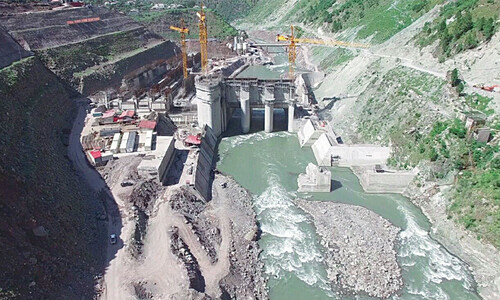
The dispute pertains to concerns raised by Pakistan over India’s construction of the 330-megawatt Kishanganga project on the Jhelum River and plans to construct the 850-MW Ratle project on the Chenab River in IIOJK. Reportedly, Pakistan considers the construction of the Kishanganga dam in India-held Kashmir over the waters flowing into the western rivers a violation of the Indus Waters Treaty 1960 since it will not only alter the course of the river but also deplete the water level of the rivers that flow into Pakistan.
In October 2022, in line with its responsibilities under the Indus Waters Treaty, the World Bank made the appointments it was mandated to make in the two separate processes requested by India and Pakistan in relation to the Kishanganga and Ratle hydroelectric power plants. Pakistan asked the World Bank to facilitate the establishment of a Court of Arbitration to consider its concerns about the designs of the two hydroelectric power projects, while India asked for the appointment of a Neutral Expert to consider similar concerns over the two projects.
Michel Lino was appointed as the Neutral Expert and Prof. Sean Murphy was appointed as Chairman of the Court of Arbitration.
The 1960 treaty recognises the World Bank as an arbitrator in water disputes between India and Pakistan as the bank played a key role in concluding this agreement. The treaty allows India to have control over the water flowing into three eastern rivers — Beas, Ravi, and Sutlej — also permitting India to use the water of western rivers — Chenab, Jhelum, and Indus — but not to divert the same. India maintains that these are “run-of-the-river” hydel projects that neither change the course of the river nor deplete the water level downstream.
Pakistan remains fully committed to the treaty’s implementation, including its dispute settlement mechanism, to ensure fair and just water sharing between the two nations.
