Monitoring Desk
The Supreme Court of Pakistan made history on Monday by live-streaming proceedings of its constitutional bench for the first time, as it resumed hearing review petitions challenging its July 2024 verdict declaring PTI eligible for reserved seats in the National Assembly.
The case has emerged as a key political flashpoint, with the outcome expected to impact the composition of the lower house.
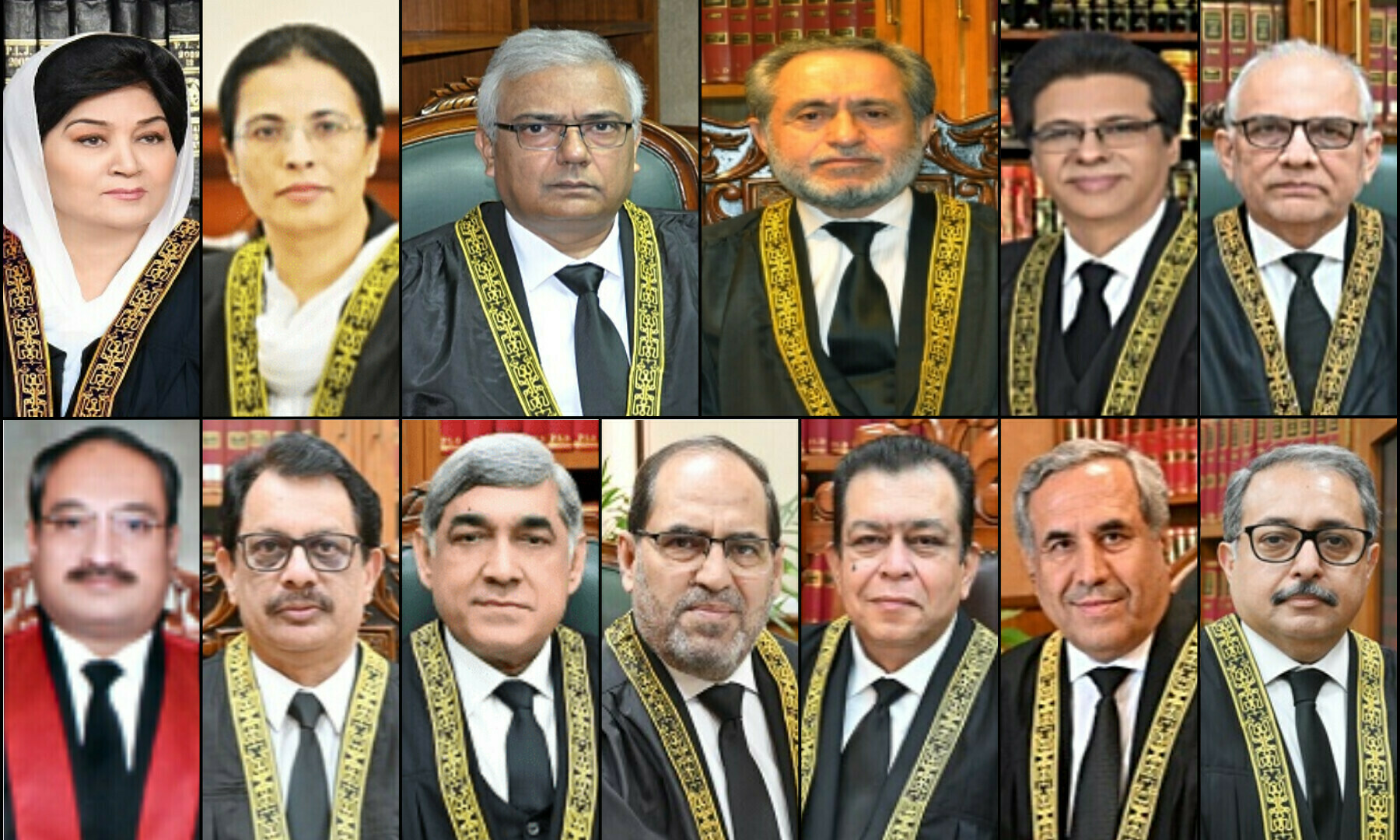
An 11-member constitutional bench, headed by Justice Aminuddin Khan, took up the review pleas filed by the PML-N, PPP, and the Election Commission of Pakistan (ECP). The pleas contest the court’s previous 8-5 ruling that declared 39 out of 80 MNAs were and remain PTI nominees—potentially making PTI the largest party in parliament.
The July 12 ruling has yet to be implemented by the National Assembly, and the ECP has voiced objections.
Judicial Divisions and Dissent
Initially, a 13-member bench had been constituted in early May, but Justices Ayesha A. Malik and Aqeel Ahmed Abbasi later recused themselves after declaring the petitions inadmissible. Justice Ayesha subsequently expressed concern to the Chief Justice over the non-publication of her dissenting opinion on the SC’s website.
In her dissent, Justice Ayesha sharply criticized the ECP for failing to implement the court’s order, warning that such defiance could undermine judicial authority and democratic values.
SIC’s Eligibility Under Scrutiny
Monday’s hearing focused heavily on the eligibility of the Sunni Ittehad Council (SIC)—the party joined by independent lawmakers backed by PTI after the 2024 elections.
Justice Musarrat Hilali questioned how independents could align with a party that had not contested elections. PTI-allied SIC had not fielded any candidates, and even its leader, Sahibzada Hamid Raza, had run as an independent.
Justice Jamal Khan Mandokhail observed that while SIC could potentially become a parliamentary party, it was not entitled to reserved seats under the Constitution or election law.
Legal Arguments and Constitutional Clauses
Senior counsel Makhdoom Ali Khan, representing PML-N and PPP, argued that several lawmakers had been denotified without due notice, in violation of legal norms. He claimed the Supreme Court’s earlier decision did not adequately address Article 255 of the Constitution, which stipulates that elections can only be challenged through designated tribunals.
Justice Muhammad Ali Mazhar countered that the court had already struck down ECP’s denotification orders, asserting that the matter of reserved seats involved proportional representation, not individual election disputes.
Reserved Seats and Political Power
In its detailed judgment, authored by Justice Mansoor Ali Shah, the court had previously condemned the ECP for “unlawful acts and omissions” that created confusion and harmed PTI’s rights and those of its voters.
The government later introduced the Elections (Second Amendment) Act, 2024, widely viewed as a legislative attempt to bypass the court’s verdict. The amendment limits the time period during which independents can join political parties after elections.
This amendment, along with a separate PTI petition regarding the denial of its election symbol, remains under review by the apex court.
Next Steps
The bench adjourned proceedings until Tuesday (tomorrow) after concluding arguments from Makhdoom Ali Khan and receiving written responses from the ECP and PML-N.
Monday’s hearing not only reignited debate over reserved seats and parliamentary legitimacy, but also marked a turning point in judicial transparency, with millions able to watch live as the nation’s top court weighed one of the most politically consequential cases in recent memory.
