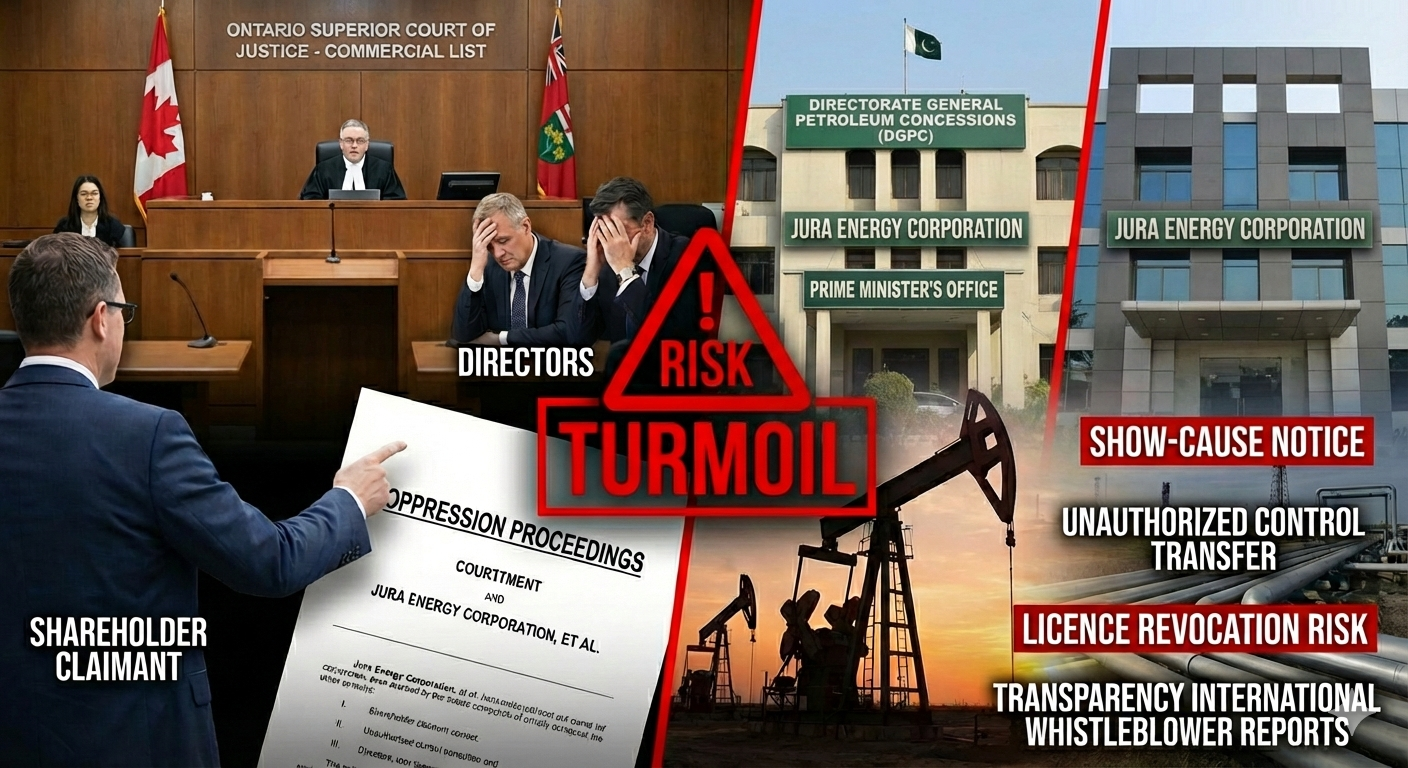
A deepening corporate crisis has engulfed Jura Energy Corporation, after a minority shareholder launched oppression proceedings in Canada and a specialized commercial court directed the company to respond within 20 days, intensifying scrutiny over governance decisions that allegedly put its petroleum licences in Pakistan at risk, it was learny.
According to industry sources,the proceedings have been initiated before Ontario’s Commercial List — a specialized branch of the Ontario Superior Court of Justice that handles complex corporate disputes. The court has sought a formal response from Jura Energy within 20 days, signaling the seriousness and urgency of the matter.
The case directly names Jura Energy Corporation along with directors Mehran Inayat Mirza, Kashif Naseem Afzal and Stephen Christopher Smith, bringing the company’s leadership under judicial examination at a time when regulatory pressure is already mounting overseas.
According to the claim, Jura’s directors permitted a transfer of effective corporate control without securing mandatory approvals required under Pakistani petroleum laws. The lawsuit argues that the company’s entire survival depends on petroleum concessions held in Pakistan through its subsidiaries Frontier Holdings Limited (FHL) and Spud Energy Pty Ltd (SPUD), and that bypassing prior governmental approval exposed those licences to regulatory action.
The shareholder contends that this decision jeopardized Jura’s only revenue-generating assets, placing the company in a position where adverse regulatory findings could directly threaten its operational existence.
However, the Canadian litigation represents only the latest chapter in a longer trail of controversies linked to Jura’s operations in Pakistan. Regulatory records and whistleblower complaints referenced in proceedings allege that Jura and its subsidiaries were previously involved in the sale of gas to a related or subsidiary entity without proper authorization, raising compliance and safety concerns.
The matter reportedly drew attention at the highest levels of government, leading to intervention by the Prime Minister’s Office and the subsequent recovery of unpaid royalty amounts that authorities had identified as outstanding. These developments intensified scrutiny of the company’s compliance practices.
Whistleblower reports submitted to Transparency International further heightened concerns, alleging violations of petroleum rules and irregularities in corporate conduct. The complaints triggered regulatory examination and contributed to the issuance of formal show-cause notices by Pakistan’s Directorate General of Petroleum Concessions (DGPC), which questioned the legality of certain corporate actions and compliance with concession agreements.
Additional allegations involving dishonoured or bounced cheques compounded the company’s difficulties, raising questions about financial discipline and internal controls. Collectively, these incidents reflected recurring friction between Jura’s subsidiaries and regulatory authorities, long before the current shareholder action surfaced in Canada.
The oppression claim now before the Ontario court asserts that the directors failed to learn from earlier controversies and instead allowed a major change in corporate control to proceed despite foreseeable regulatory consequences. The shareholder alleges that risks associated with failing to obtain prior approval were ignored or downplayed, while minority investors were not fully informed about the seriousness of ongoing legal and regulatory challenges.
The remedies being sought are sweeping. The claimant has asked the court to declare the directors’ conduct oppressive and unfairly prejudicial, compel full disclosure of corporate information, appoint an independent inspector to investigate Jura’s affairs, order a forensic accounting, and award damages — including punitive damages — against the directors personally. If granted, such measures could place the company’s governance under direct judicial oversight.
The litigation is unfolding alongside escalating legal developments in Pakistan, where courts and regulators have examined issues linked to the disputed change of control and compliance with petroleum regulations. Court proceedings referenced in related matters have directed authorities to proceed with enforcement actions under applicable petroleum rules, significantly increasing pressure on Jura’s operating subsidiaries.
Industry observers describe the company’s position as increasingly precarious: a Canadian-listed firm facing shareholder revolt at home while regulators abroad scrutinize the legality of its core operations. With its entire revenue base tied to licences that require government approval, any adverse enforcement action could carry severe consequences.
As proceedings advance on both fronts, the cumulative weight of allegations — from disputed gas sales and royalty recoveries to whistleblower complaints, show-cause notices and governance failures — has placed Jura under sustained and expanding scrutiny. The shareholder lawsuit now adds Canadian judicial oversight to an already widening regulatory front overseas.
With enforcement and potential revocation powers under petroleum rules reportedly in play, analysts warn that Jura has entered a critical phase. Should regulators proceed with decisive action, the company’s land blocks and petroleum rights could ultimately face revocation — a development that would strike at the heart of its business model.
For now, Jura Energy stands at a defining crossroads, confronting shareholder litigation, regulatory examination and judicial pressure across jurisdictions simultaneously. In corporate and regulatory circles, concern is growing that the outcome of these parallel proceedings could determine not only the fate of its operating assets, but the future of the company itself.
