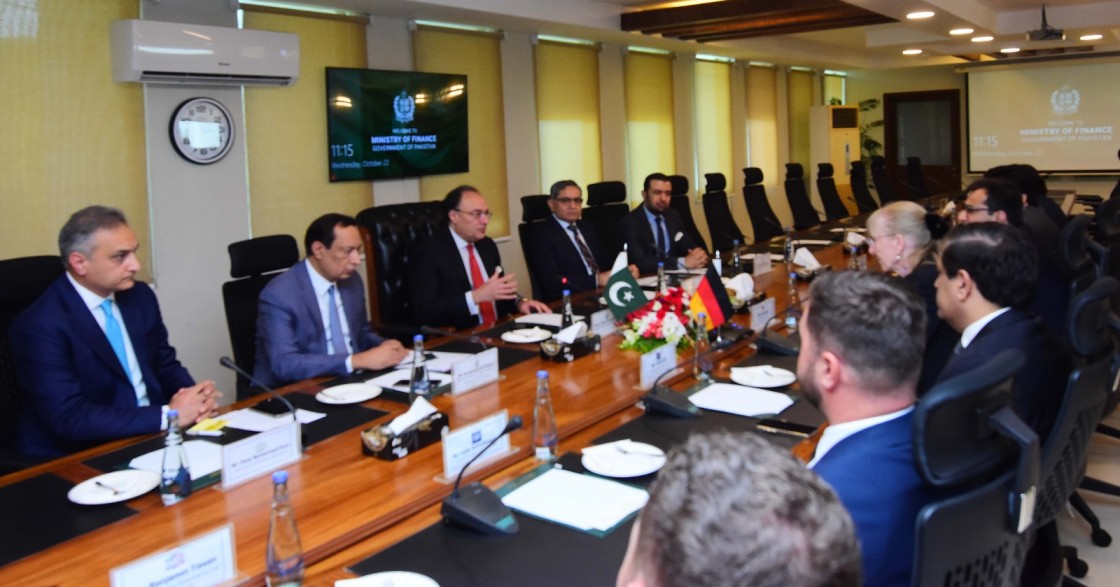
Federal Minister for Finance and Revenue Senator Muhammad Aurangzeb has urged German investors and businesses to tap into Pakistan’s rapidly growing manufacturing sector, highlighting it as one of the most promising areas for foreign investment alongside energy and technology.
The Minister made these remarks during a meeting with a delegation of German investors and businessmen led by German Ambassador to Pakistan H.E. Ina Lepel. He reaffirmed Pakistan’s strong commitment to macroeconomic stability, structural reforms, and investor facilitation, emphasizing that the country’s reform agenda is designed to build a competitive and sustainable economy.
Senator Aurangzeb outlined the government’s steady progress in restoring fiscal and external stability, maintaining a stable currency, moderating inflation, and rebuilding international confidence. He said Pakistan’s economic strategy is now anchored in deep structural reforms in taxation, energy, privatization, and public finance.
Inviting the German business community to expand their footprint in Pakistan, the Finance Minister underscored that the manufacturing sector offers vast opportunities for joint ventures and export-oriented production, given Pakistan’s strategic location, youthful workforce, and improving macroeconomic fundamentals.
He commended the Pakistan-based AHK German Bilateral Chamber of Commerce for connecting established and potential German investors with Pakistan’s evolving business environment, noting that the country’s industrial landscape is becoming increasingly conducive for value-added manufacturing.
The Minister also briefed the delegation on his recent visit to Washington D.C. for the IMF–World Bank Annual Meetings, where he met global investors, multilateral partners, and credit rating agencies — all of whom acknowledged Pakistan’s renewed reform momentum and macroeconomic consolidation.
Senator Aurangzeb said that Pakistan’s currency remains stable, with foreign exchange reserves covering about two and a half months of imports and expected to reach three months by fiscal year-end. Inflation, he added, is projected between 5% and 7% for FY2025, supported by easing monetary policy.
He noted that major credit rating agencies — Fitch, S&P, and Moody’s — have upgraded Pakistan’s outlook, while the IMF’s recent staff-level agreement further validates the country’s economic direction.
On the reform front, the Minister said broadening the tax base remains a top priority, with the tax-to-GDP ratio targeted to rise from 10.2% to 11% this year and up to 13% in subsequent years. He also outlined the government’s plan to reduce fiscal losses through energy sector reforms and privatization, revealing that 34 state-owned enterprises have been transferred to the Privatization Commission.
“Pakistan International Airlines (PIA) privatization is moving forward with four major international groups conducting due diligence,” he said, adding that such steps signal Pakistan’s seriousness in pursuing structural reforms.
Aurangzeb also discussed Pakistan’s plans to re-enter international capital markets through the issuance of a Panda Bond in China and a Eurobond under the Global Medium-Term Note (GMTN) program by 2026.
He assured the German investors that Pakistan’s improving fundamentals, expanding industrial base, and strengthened engagement with global partners including Europe, China, and the Gulf, make it an opportune time to invest — particularly in manufacturing, technology, and renewable energy.
