Staff Report
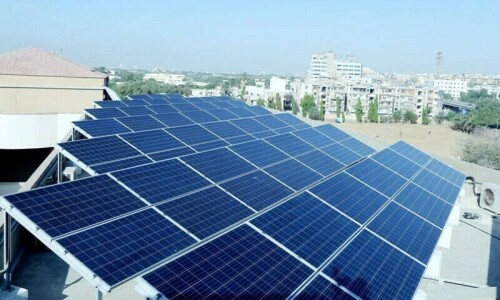
ISLAMABAD: In a major policy shift that could slow down the adoption of solar energy, the government has slashed the buyback rate for net-metering consumers by one-third to Rs10 per unit and scrapped net billing, making solar investments less attractive.
The decision, which applies to new net-metering users, was approved by the Economic Coordination Committee (ECC) of the Cabinet in a meeting chaired by Finance Minister Muhammad Aurangzeb on Thursday.
Under the revised policy, power companies will now purchase surplus solar electricity from consumers at Rs10 per unit, while grid electricity will continue to be sold at Rs42 per unit (off-peak) and Rs48 per unit (peak)—excluding taxes and duties.
Additionally, solar system installations exceeding sanctioned load will no longer be allowed, except for a 10% cushion, compared to the previous 50% allowance. Existing solar users will gradually transition to this framework as their seven-year contracts expire.
Govt Justifies the Move, But Faces Backlash
The Power Division defended the decision, arguing that net-metering consumers were shifting financial burdens onto grid users, adding nine paisas per unit to overall electricity costs. Officials projected that this burden—currently Rs101 billion annually—could skyrocket to Rs545 billion (Rs3.6 per unit) by 2034 if the current net-metering policy remained unchanged.
However, the move drew sharp criticism from cabinet members. Petroleum Minister Ali Pervez Malik warned that the decision sends a negative signal to both investors and consumers and could have been handled more strategically.
Meanwhile, Power Minister Awais Leghari argued that affluent urban consumers had been benefiting from low-cost solar power while avoiding capacity and transmission charges, worsening the financial strain on the power sector.
One official noted that urban salaried consumers, already paying high taxes and relying on expensive and unreliable grid electricity, will now be forced to sell surplus solar power at Rs10 per unit while buying it back at Rs65-70 per unit during peak hours. This shift, the official said, could drive many consumers toward costly battery storage or complete off-grid solutions.
No Stakeholder Consultation Raises Concerns
The Power Division moved forward with the decision without seeking input from key stakeholders, including the National Electric Power Regulatory Authority (Nepra), the Federal Board of Revenue (FBR), and the Ministry of Finance. Officials claimed that the policy summary was shared with Nepra, the Ministry of Industries, and the National Energy Efficiency and Conservation Authority (Neeca), but their feedback was not considered due to the urgency of the matter.
The ECC authorized the Power Division to direct Nepra to revise the buyback rate and adjust it periodically in the future.
Additionally, exported and imported electricity units will now be billed separately. Consumers cannot cash out excess solar credits—instead, any surplus will be carried forward to the next billing cycle.
Regulatory Adjustments & Rising Solar Adoption
To manage the growing number of net-metering consumers, Nepra will introduce caps on the hosting capacity of transformers and feeders. Additionally, solar inverters must now meet stricter real-time grid interaction standards, including Wi-Fi and GSM-based communication with distribution companies (Discos).
The government highlighted that record-low solar panel prices have led to a surge in solar adoption. By December 2024, the number of net-metering consumers reached 283,000, up from 226,440 in October 2024. Officials warned that without intervention, solar net-metering consumers would shift a financial burden of Rs4.24 trillion onto grid users by 2034.
Other Key ECC Decisions
The ECC also approved a summary from the Ministry of Maritime Affairs, allowing Agven Private Ltd (operating in the Gwadar North Free Zone) to export up to 10,000 tonnes of potassium sulphate fertiliser annually until December 31, 2025. The move is part of efforts to develop Gwadar’s Free Zone while ensuring regulatory oversight.
Additionally, the ECC approved Rs1.2 billion in supplementary grants, including:
Rs250 million for the Ministry of Federal Education,
Rs220 million for the Ministry of Industries to support small and medium enterprises (SMEs),
Rs36.1 million for the Ministry of Interior for Sindh Rangers’ helicopter maintenance,
Rs15 million for Frontier Corps Balochistan’s helicopter maintenance,
Rs670 million for Sustainable Development Goals (SDG) initiatives in Islamabad.
