
Special Report
ISLAMABAD: The appointment of Mr. Riaz Ali as Acting Director General of Petroleum Concessions (DGPC) initially seemed routine. However, as his 90-day tenure draws to a close, its impact on Pakistan’s energy sector has been catastrophic. Policy inconsistencies, administrative disarray, and a breakdown in stakeholder confidence have left the industry on the edge, with urgent calls for his removal.
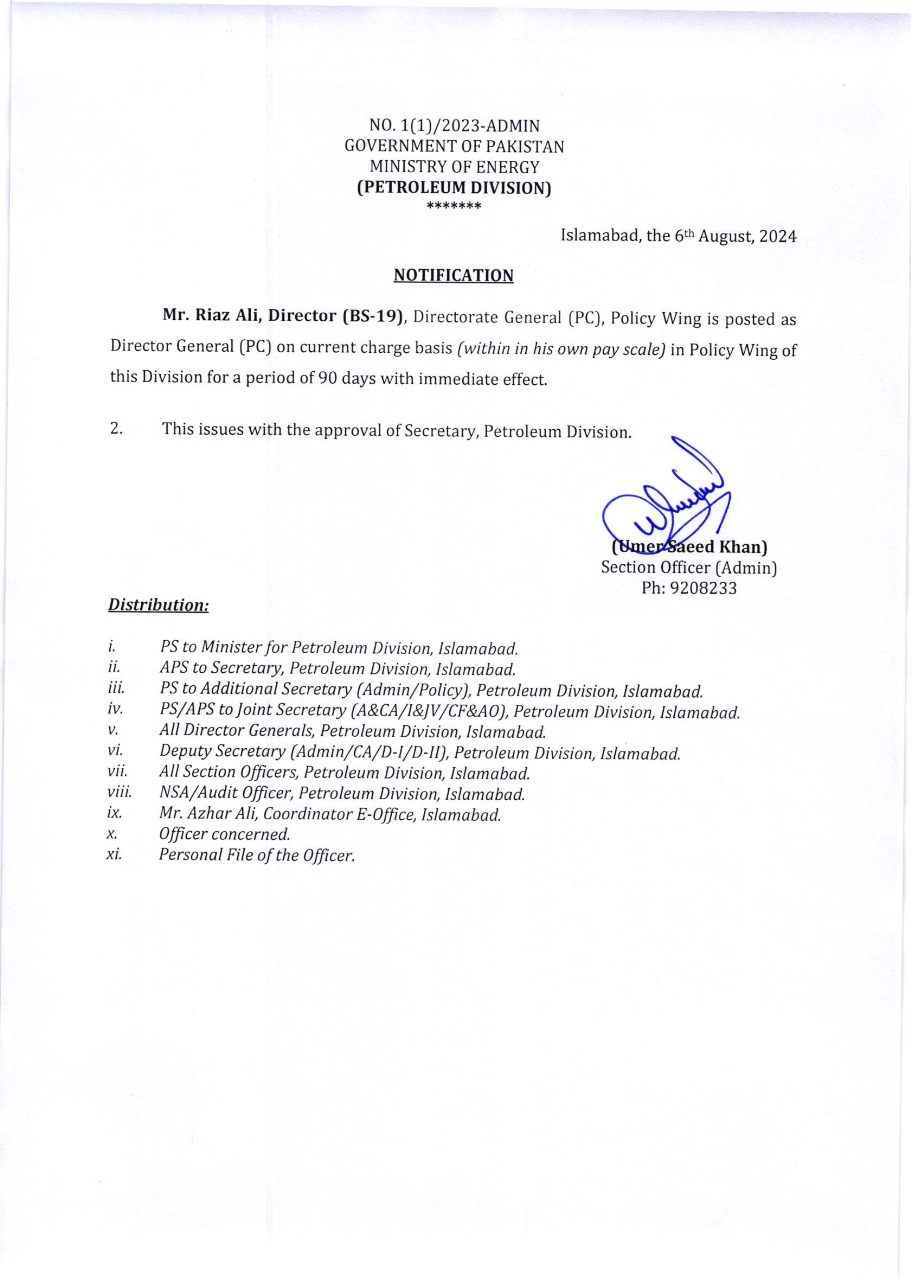
Initially it was viewed as a routine appointment, the decision to assign Mr. Riaz Ali as the Acting Director General of Petroleum Concessions (DGPC) for a 90-day tenure has proven catastrophic for Pakistan’s energy sector. However, now, as those 90 days come to an end, the consequences of his leadership—or lack thereof—are becoming alarmingly clear. Under his watch, the DGPC has spiraled into chaos, characterized by policy inconsistencies, disillusioned officers, and a complete breakdown in stakeholder confidence. The outcome? An industry on the verge of collapse, with calls for his immediate removal growing louder by the day.
A Leader Without a Vision
Mr. Riaz Ali’s 90-day stint as DGPC has been marred by policy inconsistency and administrative incompetence. Frameworks that were already in motion, such as the regulations for third-party gas sales, have seen no progress under his leadership. This lack of implementation has caused private sector stakeholders to question whether the current DGPC even has the capability—or the willingness—to follow through on critical initiatives that could reinvigorate the industry. The result is a growing number of high-level officers planning to leave the Directorate, disillusioned by the disarray that has defined the last three months.
A Legacy of Questionable Decisions
Perhaps the most glaring example of Mr. Riaz Ali’s questionable leadership is the illegal extension of the development and production lease for the Sui Gas Field. This lease was not just extended; it was approved for 10 years retrospectively, effective from June 2015, raising serious ethical and legal red flags. The move has been widely criticized as a blatant violation of regulatory norms and has been viewed as an attempt to curry favor with entrenched interests at the expense of national energy policy.
Further complicating his tenure are allegations of favoritism toward defaulting companies that have little to no assets left in the country. Such decisions are not only illegal but also destabilize the competitive landscape, driving away potential investors and undermining the integrity of the DGPC’s regulatory framework.
A Conflict of Interest and Unfulfilled Promises
In addition to his policy missteps, Mr. Riaz Ali attempted to orchestrate the hiring of employees from external companies, a move that sparked immediate backlash due to its blatant conflict of interest. This attempt to bring in outside professionals from private companies has drawn criticism from both inside and outside the Directorate, casting further doubt on Mr. Riaz’s judgment and motives.
Under his leadership, stakeholder feedback has been overwhelmingly negative. Where his predecessors successfully navigated Senate and National Assembly meetings, secured ECC decisions, and implemented policy changes, Mr. Riaz Ali has failed to produce any comparable achievements. The silence from stakeholders—once vocal supporters of progressive energy policy—speaks volumes about their lack of confidence in his ability to steer the DGPC in the
right direction.
A Personal Crisis Amidst Professional Failure
Adding to this grim picture is the personal health crisis that Mr. Riaz Ali experienced during his tenure: a heart attack brought on by the pressures of the job. While it is human to feel empathy for such situations, it is also important to recognize that this health issue has further compounded the instability at the DGPC. An incapacitated leader struggling to manage the intense demands of one of Pakistan’s most vital regulatory bodies serves neither the industry nor the nation.
A Mere Shadow of His Predecessor
Mr. Riaz Ali’s leadership pales in comparison to the DGPCs who came before him, figures who managed to maintain order, transparency, and stakeholder engagement even in the face of considerable challenges. These past leaders facilitated crucial policy reforms, attended to national matters with diligence, and implemented frameworks that pushed the energy sector forward. Under them, the DGPC was an office of action and progress. Under Mr. Riaz, it has become an office of stagnation and crisis.
A Call for Change
The reality is clear: Mr. Riaz Ali’s tenure has not only failed to move the DGPC forward but has actively set it back. The inconsistent policies, illegal decisions, demoralized workforce, and conflict of interest scandals that have defined his 90 days in office have pushed Pakistan’s energy sector to the brink. If the country is to salvage what remains of its upstream industry, it needs strong, knowledgeable leadership at the DGPC. It is time for Mr. Riaz Ali to step down and make way for someone who can navigate these turbulent waters with competence and integrity.
It is worth noting that Riaz Ali, a Director (BS-19) within the Directorate General (PC), Policy Wing, was appointed as the acting Director General of Petroleum Concessions (DGPC) on August 6, 2024, on a current charge basis for a period of 90 days. However, his brief tenure has reportedly left Pakistan’s energy sector in turmoil. Allegations of policy inconsistency, administrative confusion, and waning stakeholder trust have surfaced, with staff disillusionment further highlighting the leadership crisis. As the end of his 90-day term approaches, industry voices are calling for his immediate replacement to prevent further instability in this critical sector.
