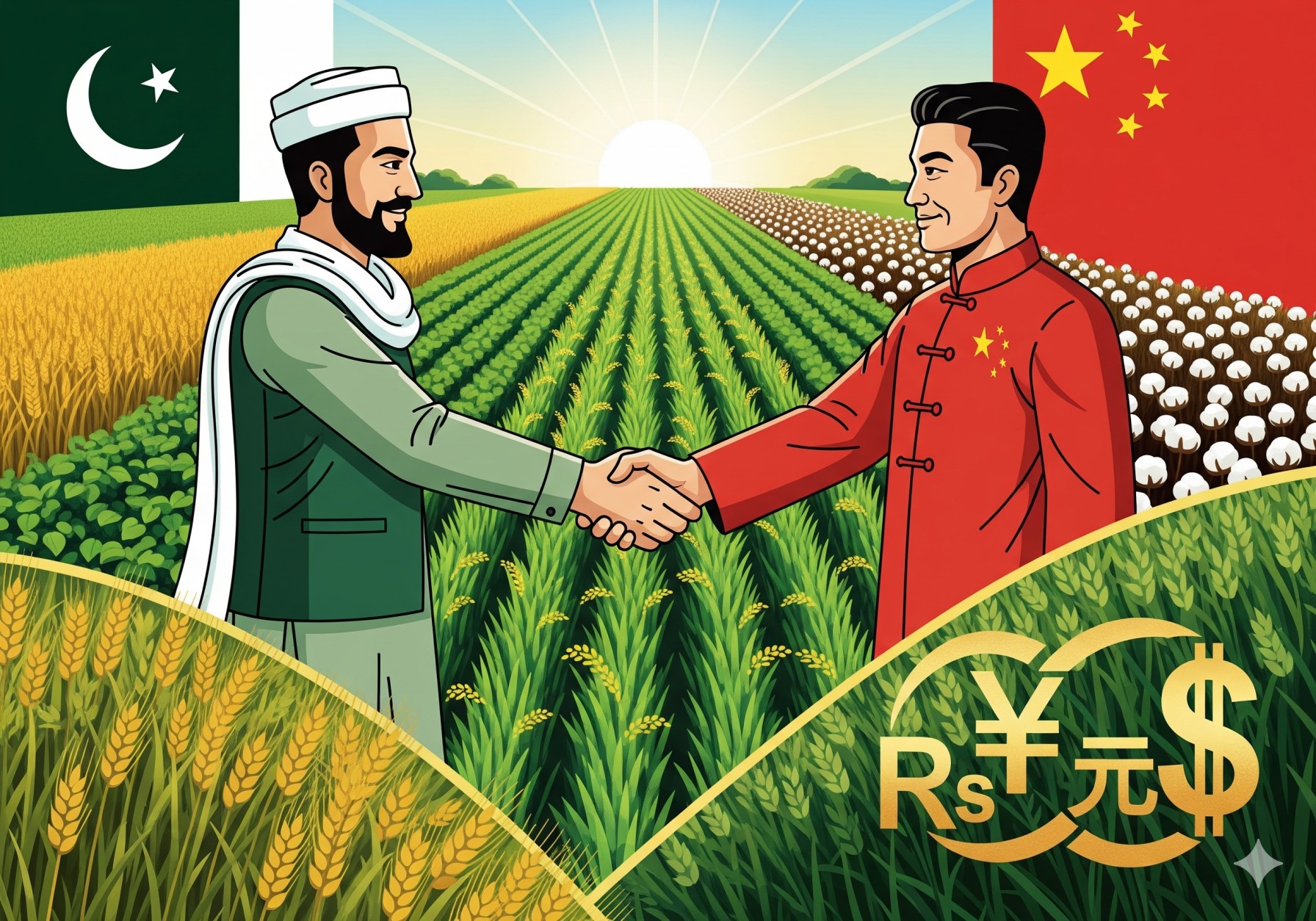
Pakistan and China signed more than two dozen memorandums of understanding (MoUs) worth $4 billion on Saturday to enhance cooperation in agriculture technology, including mechanisation, seed development, smart farming, and precision agriculture aimed at boosting productivity and food security.
The agreements were finalized during the Pak-China Business-to-Business (B2B) Conference in Beijing, held alongside Prime Minister Shehbaz Sharif’s visit to China. The signing ceremony was witnessed by Federal Minister for National Food Security and Research Rana Tanveer Hussain, who termed the collaboration a “transformative step” for Pakistan’s agriculture sector.
“These agreements will not only strengthen Pakistan’s food security but also open new avenues for sustainable bilateral cooperation in agri-technology and innovation,” Mr Hussain said.
The one-day conference included opening and closing ceremonies and featured multiple B2B sessions. The minister also held a series of meetings with leading Chinese and Pakistani agribusiness companies, including Dayu (irrigation sector), Jessica EV, PIESAT, LOVOL (agricultural machinery), Sanyang Company Xinjiang, Jinghua Seed Industry, Guard Agricultural Research and Services, and China State Engineering Construction Corporation GDSP.
One of the most significant agreements was signed between Pakistan and PIESAT, a Chinese aerospace company, valued at $406.4 million. The deal, almost double PIESAT’s total revenue last year, will support the development of a satellite constellation to improve communication and data-driven agriculture practices.
The first phase of the project includes the launch of 20 satellites, establishment of a satellite manufacturing facility, development of supporting software, and transfer of technical know-how to help Pakistan build its own satellite manufacturing and operational capabilities.
Highlighting China’s $215 billion annual agricultural imports, Mr Hussain said Pakistan can play a key role as a supplier of tropical and temperate fruits, vegetables, and cereal crops. He noted that Pakistan’s geographic proximity and competitive pricing give it a strategic advantage over suppliers such as Brazil and other Western nations.
The minister praised both Pakistani and Chinese agribusiness initiatives under the leadership of PM Shehbaz, reaffirming Pakistan’s commitment to long-term agricultural partnerships with Beijing.
Analysts say these agreements could help modernize Pakistan’s agriculture sector, improve yields through advanced technology, and significantly expand Pakistan’s export potential to meet China’s growing food demand.
