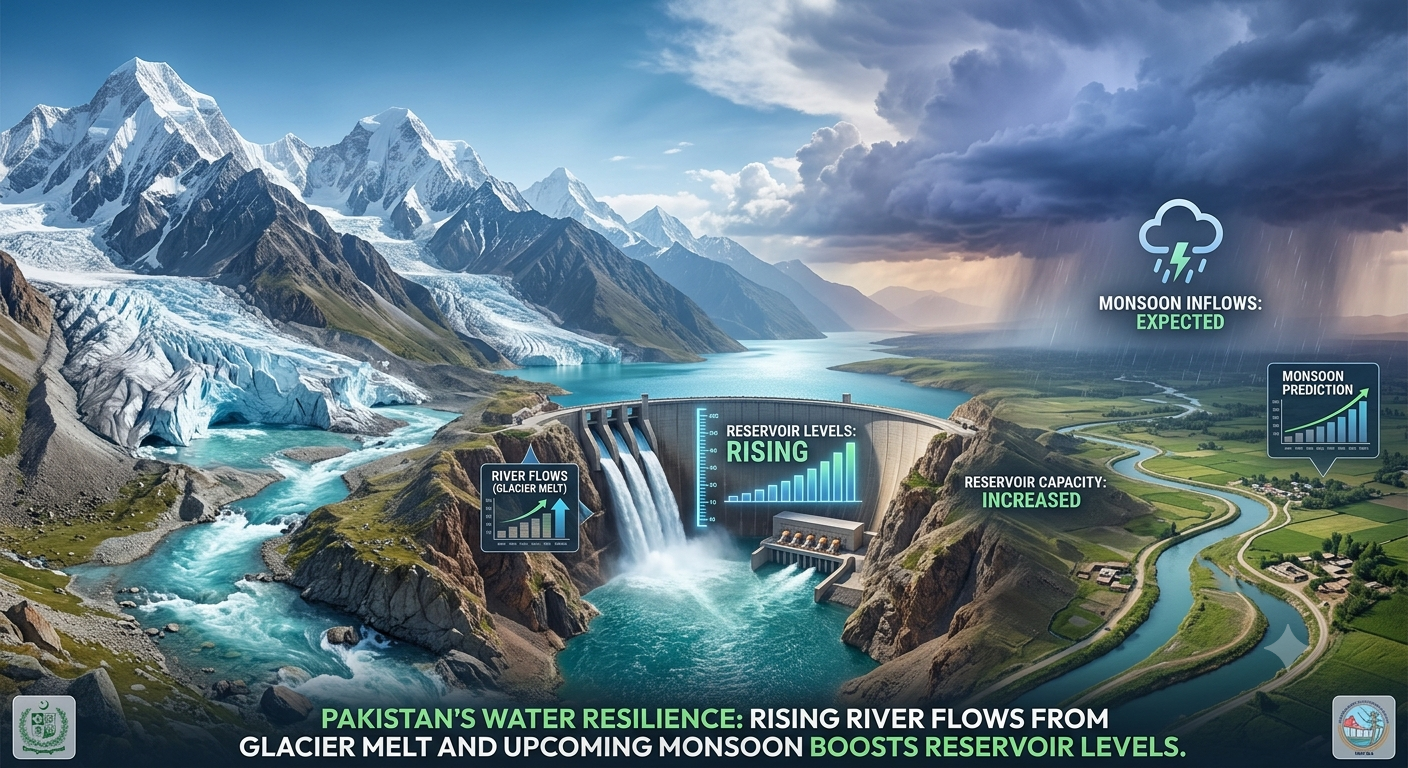
ISLAMABAD: Pakistan’s major rivers and water reservoirs have begun registering a steady improvement in water availability as rising temperatures in the country’s northern mountainous regions accelerate glacier melting, with water authorities expecting the upcoming monsoon season to further enhance river inflows, reservoir storage and overall water availability.
According to the latest official hydrological data, increasing glacier melt has significantly improved flows in the Indus River system, resulting in higher water storage in the country’s major reservoirs, a development expected to benefit irrigation supplies, hydropower generation and water management.
The Indus River at Tarbela recorded an inflow of 226,500 cusecs, while water releases stood at 150,300 cusecs, indicating a substantial rise in river discharge.
The Jhelum River at Mangla registered 37,600 cusecs of inflows and 38,700 cusecs of outflows.
On the Chenab River at Head Marala, inflows reached 63,700 cusecs, while outflows were measured at 36,900 cusecs.
Meanwhile, the Kabul River at Nowshera recorded both inflows and outflows of 48,000 cusecs, reflecting stable river conditions.
At Khairabad Bridge, the Indus River carried 198,000 cusecs of both inflows and outflows.
Water releases across the country’s major barrages also reflected improved river conditions.
Jinnah Barrage recorded inflows of 207,500 cusecs and outflows of 200,800 cusecs.
Chashma Barrage received 205,000 cusecs of water and discharged 203,000 cusecs.
At Taunsa Barrage, inflows stood at 178,900 cusecs, while 163,200 cusecs were released downstream.
Further downstream, Guddu Barrage recorded inflows of 132,300 cusecs and outflows of 101,100 cusecs, while Sukkur Barrage received 92,000 cusecs and released 41,200 cusecs.
Kotri Barrage registered inflows of 43,300 cusecs, with no downstream releases recorded.
Similarly, Trimmu Barrage recorded inflows of 33,800 cusecs and outflows of 18,200 cusecs, while Panjnad Barrage received 9,000 cusecs without any downstream discharge.
The gradual increase in river flows has also improved storage levels in Pakistan’s three major reservoirs.
According to officials, the combined live storage in Tarbela, Mangla and Chashma reservoirs has reached 3.403 million acre-feet (MAF).
At Tarbela Reservoir, the water level was recorded at 1,453.07 feet, compared with its minimum operating level of 1,402 feet and maximum conservation level of 1,550 feet. Live storage stood at 1.111 MAF.
At Mangla Reservoir, the water level reached 1,162.85 feet, above the minimum operating level of 1,050 feet, while remaining below the maximum conservation level of 1,242 feet. Live storage was recorded at 2.243 MAF.
At Chashma Reservoir, the water level stood at 641.30 feet, compared with a minimum operating level of 638.15 feet and a maximum conservation level of 649 feet. Live storage was recorded at 0.049 MAF.
Officials attributed the gradual improvement in reservoir levels primarily to accelerated glacier melting triggered by rising temperatures in the country’s northern high-altitude regions.
They said water availability across Pakistan’s river system is expected to improve further with the onset of the monsoon season, which is likely to increase river inflows, reservoir storage and downstream water releases over the coming weeks.
According to the authorities, the reported inflows and outflows for the Indus River at Tarbela, Jinnah and Chashma, the Kabul River at Nowshera, and the Jhelum River at Mangla represent average flows recorded over a 24-hour period, while readings for the remaining rivers and barrages were measured at 6:00 a.m.
