Monitoring Desk
In a high-stakes security meeting, Pakistan’s top civil and military leadership called for urgent implementation of counterterrorism strategies to combat the rising wave of terrorism, as Army Chief Gen Asim Munir warned that governance failures were impeding national security efforts. The meeting, convened by the Parliamentary Committee on National Security (PCNS), underscored the need for national unity and swift action against militant threats.
A communique issued after the meeting emphasized the immediate execution of the National Action Plan (NAP) and Azm-i-Istehkam strategy to dismantle terrorist networks, disrupt logistical support, and eliminate links between terrorism and organized crime. The committee also stressed the importance of political consensus and the full strength of the state in tackling terrorism.
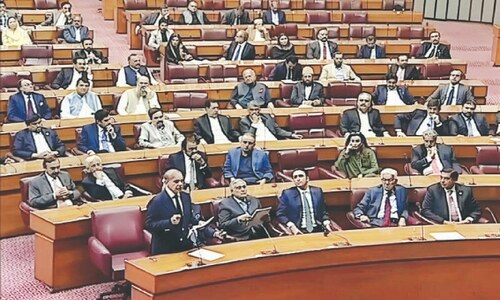
The high-level gathering, chaired by National Assembly Speaker Ayaz Sadiq, was attended by Prime Minister Shehbaz Sharif, senior political leaders, military officials, and intelligence representatives. The session was called amid a deteriorating security situation, particularly in Khyber Pakhtunkhwa and Balochistan, with last week’s hijacking of the Jaffar Express highlighting the growing threat.
Gen Munir, in his address, emphasized that counterterrorism efforts must go beyond military operations, calling for a holistic approach that integrates all elements of national power. “This is a war for our survival and that of our future generations,” he said. However, he cautioned that weak governance structures were undermining these efforts.
“How long will we continue to fill governance gaps with the sacrifices of the Pakistan Army and the blood of martyrs?” he questioned. “We need better governance to make Pakistan a hard state. How long will we continue to sacrifice countless lives under the model of a soft state?”
Pakistan’s counterterrorism policies have evolved over the years, beginning with NAP in 2014 after the Army Public School attack. The framework was revised in 2021 following the U.S. withdrawal from Afghanistan. In June 2024, Operation Azm-i-Istehkam was launched under the current government in response to the escalating security crisis.
Despite these initiatives, the military has repeatedly pointed out shortcomings in civilian implementation of counterterrorism policies. Notably, neither the PCNS communique nor Gen Munir’s remarks—as relayed by Inter-Services Public Relations (ISPR)—addressed the role of the Afghan Taliban in harboring Tehreek-e-Taliban Pakistan (TTP) militants. However, recent official narratives have blamed Taliban-controlled Afghanistan for the resurgence of terrorism in Pakistan.
The meeting also discussed the growing threat of digital terrorism, expressing concerns over the misuse of social media by militant groups for propaganda, recruitment, and coordination of attacks. The committee called for a comprehensive framework to counter extremist narratives online and dismantle digital terror networks.
A key political development during the session was the boycott by PTI and its allied lawmakers from Tehreek-i-Tahaffuz-i-Ayeen-i-Pakistan. They had demanded permission to meet their jailed leader, Imran Khan, but after their request was denied, they chose to skip the meeting.
In a veiled criticism of the opposition’s absence, Gen Munir reaffirmed that national security must take precedence over political rivalries. “There is no agenda greater than the security of the country—no movement, no individual. If this country exists, then we exist. Therefore, nothing is more important to us than the security of the country,” he said.
Despite the opposition’s boycott, the military leadership reassured that national security efforts remained unwavering. “Those who think they can weaken Pakistan through these terrorists should take today’s message: We stand united and will not only defeat them but also their facilitators,” Gen Munir declared.
The PCNS reinforced this position, stating that no institution, individual, or group collaborating with enemy forces would be allowed to disrupt Pakistan’s peace and stability. While the committee expressed regret over the absence of opposition members, it reaffirmed that national security consultations would continue.
