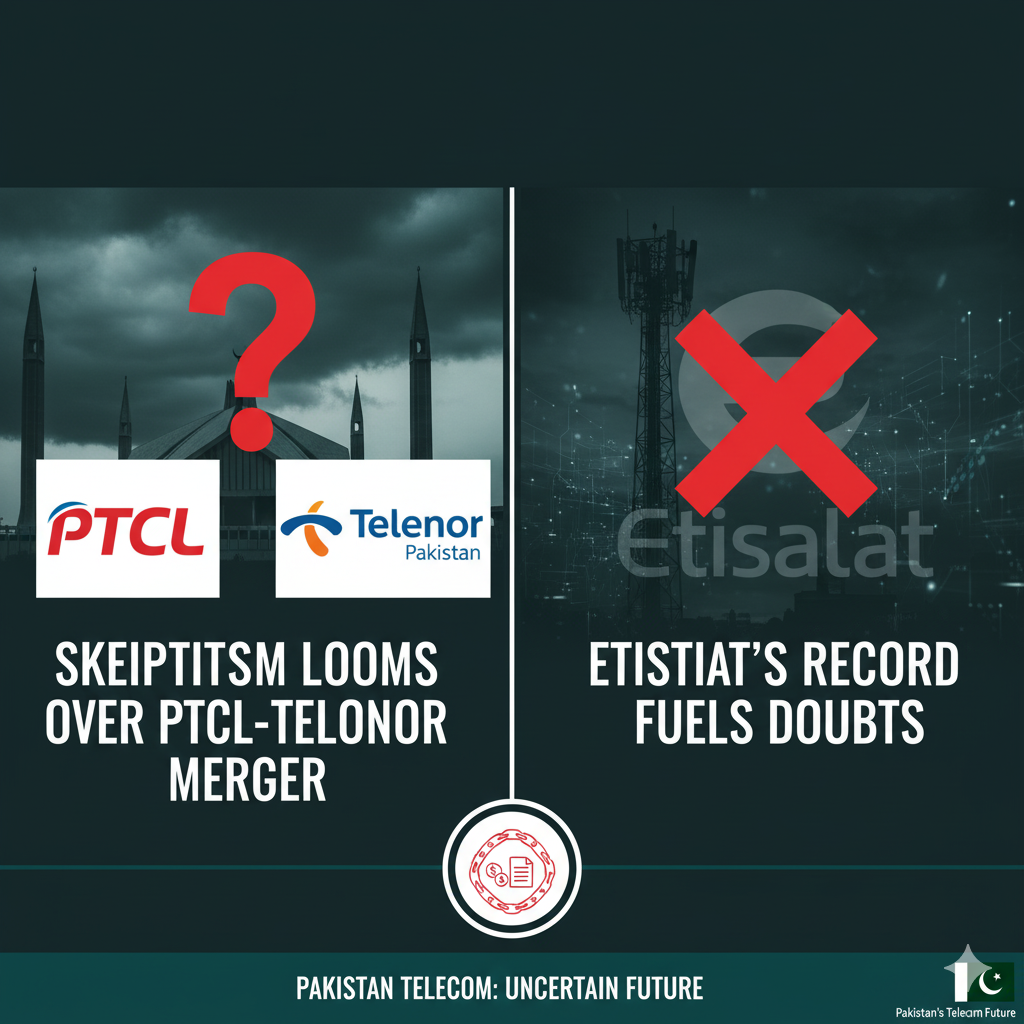
The Competition Commission of Pakistan (CCP) has conditionally approved Pakistan Telecommunicaion Company Limited’s (PTCL) acquisition of Telenor Pakistan, but lingering concerns over Etisalat’s reputation and PTCL’s past conduct continue to cloud the landmark transaction.
The $400 million deal will give PTCL full ownership of Telenor Pakistan (Pvt.) Ltd. and Orion Towers (Pvt.) Ltd. CCP officials, however, emphasized that the merger’s continuation hinges on strict compliance, warning that violations or anti-competitive practices could trigger revocation. At a press conference on Wednesday, CCP Member Salman Amin underscored that PTCL and the merged entity must keep separate accounts to prevent cross-subsidization. He pointed out that Ufone’s losses had already placed a financial burden on PTCL, raising concerns about the impact of consolidation.
CCP Chairman Dr. Kabir Ahmed Sidhu described the review as one of the most complex transactions the regulator had ever handled. He explained that the Commission examined precedents from the United States, United Kingdom, and European Union before granting its conditional approval, calling it “one of the most complicated transactions in the entire world.”
Despite the regulatory nod, skepticism lingers in the market. Etisalat, PTCL’s parent company, has yet to clear $800 million in outstanding dues from PTCL’s original privatization deal. The company has also faced repeated criticism over questionable property transactions. PTCL itself has a history of challenging regulators and once obtained a stay order against the Pakistan Telecommunication Authority, raising doubts about whether it will fully comply with CCP’s directives. When asked whether PTCL might pursue legal remedies to avoid obligations, Chairman Sidhu dismissed the possibility, saying the company had given written undertakings to comply. He assured that PTCL would submit regular compliance reports, and the CCP would monitor progress for five years to ensure implementation.
The Commission’s decision imposes extensive obligations on PTCL and the merged entity. They must maintain independent governance structures with separate boards and management teams. Leadership appointments will be subject to competency and integrity requirements, and an independent third-party reviewer will oversee compliance, submit quarterly reports, and audit progress for five years. Related-party transactions will only be allowed if conducted at arm’s length, while non-discriminatory access to interconnection and capacity sharing will be mandatory under the Pakistan Telecommunication Authority’s supervision. Wholesale pricing for IP bandwidth, long-distance services, and leased lines must receive PTA approval, and predatory pricing is strictly prohibited.
Consumer protection remains central to the conditions. PTCL and the merged entity are required to comply with service quality standards, secure tariff approvals, and demonstrate that their promised efficiencies actually benefit consumers in the form of lower costs, wider coverage, and improved services. The Commission has also reserved the right to order divestiture of assets if evidence emerges of anti-competitive conduct or violations of the approved conditions. Senior legal advisor Ambreen Abbasi explained that the safeguards were designed after assessing risks to competition, levels of market concentration, and the validity of efficiency claims. She noted that the merger was cleared only after ensuring a framework to prevent predatory behavior and guarantee consumer benefits.
Supporters of the merger argue that it will consolidate around 24,000 telecom sites, reduce duplication, and accelerate the rollout of 5G services across the country. They believe the integration could expand coverage and improve data quality, particularly in underserved rural areas where connectivity gaps remain. However, industry experts remain cautious, pointing out that Etisalat’s unresolved legacy issues and PTCL’s history of litigation may complicate smooth execution.
For now, the PTCL–Telenor deal stands as the largest consolidation in Pakistan’s telecom sector in more than a decade. Its success will depend not only on operational efficiency and technological upgrades but also on whether PTCL and Etisalat can win the trust of regulators, competitors, and consumers by adhering to the strict conditions set by the CCP.
