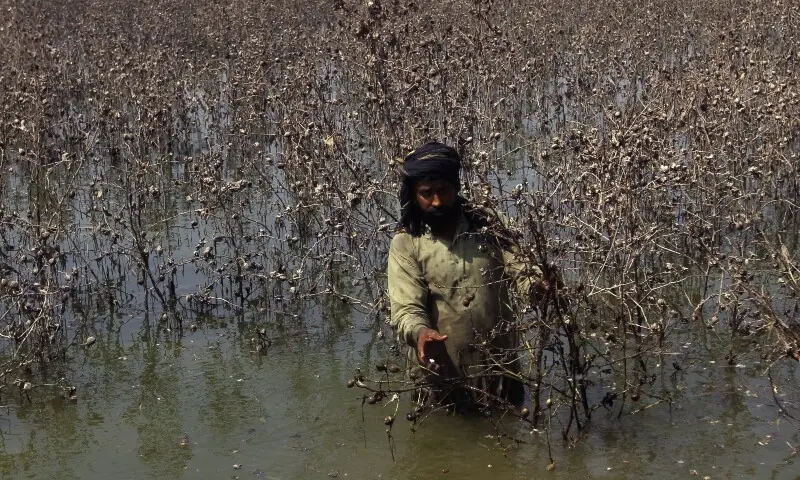
The World Bank has downgraded Pakistan’s economic growth forecast to 2.6% for FY2025–26, citing the devastating effects of floods that have damaged crops, disrupted food supplies, and reignited inflationary pressures.
In its latest Regional Economic Outlook for the Middle East, North Africa, Afghanistan, and Pakistan (MENAAP), the Bank said the “ongoing catastrophic floods” had dampened growth prospects, revising its April estimate of 3.1% downward. Pakistan’s own growth target of 4.2%, later adjusted to 3.5% under IMF commitments, now appears increasingly difficult to achieve.
“Early estimates suggest a 10% drop in agricultural output in Punjab, affecting major crops such as rice, sugarcane, cotton, wheat, and maize,” the report stated.
The floods are also expected to push inflation to 7.2%, reversing recent improvements when price pressures briefly fell to single digits.
Recovery Prospects and Reforms
The World Bank expects a modest rebound to 3.4% growth in FY2026–27, driven by improved agricultural performance, lower inflation, and a recovery in private investment. It said Pakistan’s newly approved five-year tariff reform plan (2025–2030) — which aims to halve import duties — could help boost exports and competitiveness.
Poverty and Trade Concerns
While poverty had fallen by 9.4 percentage points between 2011 and 2018, the report warned that repeated economic shocks and natural disasters since 2020 have stalled progress. Pakistan now accounts for one of the largest shares of the poor within the MENAAP region, the Bank noted.
The report also projected a 1.5% decline in exports, citing weakened global demand and logistical disruptions following the floods.
Regional and Gender Dynamics
Regionally, MENAAP’s growth is expected to improve to 2.8% in 2025 and 3.3% in 2026, led by Gulf economies benefiting from non-oil sector expansion. However, ongoing conflicts, trade policy shifts, and displacement remain risks.
The World Bank also underscored the potential of women’s economic inclusion, noting that only one in five women in the region participates in the labour force — the world’s lowest rate.
“Increasing female participation could boost GDP per capita by 20–30% in countries like Egypt, Jordan, and Pakistan,” said Roberta Gatti, Chief Economist for the MENAAP region.
Pakistan, despite making eight key workplace and pay reforms since 2010, continues to face barriers as two-thirds of college-educated women remain out of the labour force, often due to social norms and early marriage.
Demographic Transition
With a fertility rate of 3.5, among the highest in the region, Pakistan’s demographic shift is expected to mirror its regional peers within a generation, eventually dropping below replacement levels, the Bank said.
